
Introduction
Starting a learning journey can feel exciting, but it can also become overwhelming when you are unsure which resources to use. Today, thousands of digital platforms promise better learning experiences, yet many beginners struggle to find tools that are both effective and completely free. The good news is that you do not need expensive software or premium subscriptions to improve your study routine. The Best Free Study Tools for Beginners can help you organize your notes, manage your time, practice new concepts, and stay motivated without spending a single dollar.
Whether you are a school student, college learner, self-taught professional, or someone preparing for competitive exams, choosing the right study tools can save valuable time. Instead of relying on random websites, you can build a productive learning system using trusted free resources designed for different learning styles.
Many successful learners combine note-taking applications, flashcard platforms, focus timers, cloud storage, and online learning resources to create an organized workflow. These tools help reduce distractions, improve memory, and make studying more enjoyable.
In this guide, you will discover the Best Free Study Tools for Beginners, understand why they matter, learn how to use them effectively, and explore practical strategies for building better study habits. By the end, you will know exactly which free tools deserve a place in your daily learning routine and how to make the most of every study session.
What is Best Free Study Tools for Beginners?
The Best Free Study Tools for Beginners are digital applications, websites, and online platforms that help learners study more effectively without requiring payment. These tools support different aspects of learning, including note-taking, scheduling, memorization, research, collaboration, and productivity.
Unlike expensive educational software, free study tools provide essential features that are enough for most beginners. They help students stay organized while reducing the financial burden of purchasing premium learning resources.
Some study tools focus on improving concentration, while others help learners remember information through quizzes, flashcards, or spaced repetition. There are also tools that simplify teamwork, document sharing, and assignment planning.
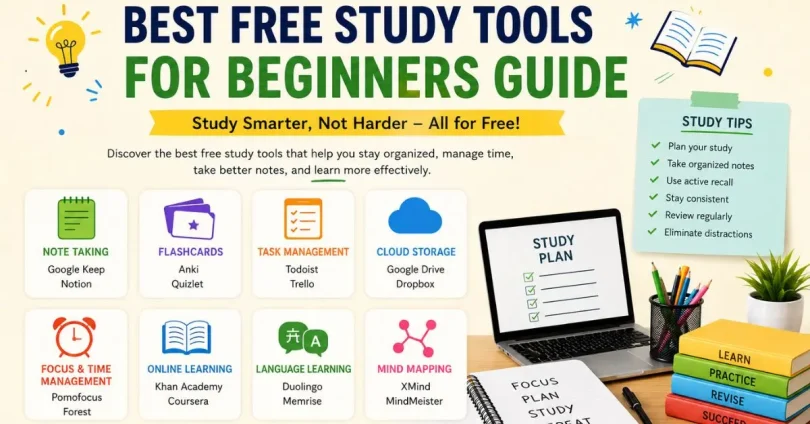
The best study tools usually fall into several categories:
- Note-taking applications
- Flashcard creators
- Task management tools
- Online document editors
- Calendar and scheduling apps
- Focus and productivity timers
- Cloud storage platforms
- Learning websites
- Language learning applications
- Mind mapping software
Each category serves a different purpose, allowing students to create a personalized study system that matches their goals.
For example, a beginner preparing for exams may use one tool for writing notes, another for creating flashcards, and a third for tracking daily study sessions. Together, these free resources create a complete learning environment without requiring costly subscriptions.
The greatest advantage of using the Best Free Study Tools for Beginners is accessibility. Most tools work on computers, tablets, and smartphones, making it possible to study anytime and anywhere.
Why is Best Free Study Tools for Beginners Important?
Choosing the right study tools is about more than convenience. They directly influence how efficiently students learn, remember information, and complete assignments.
Here are several reasons why these free tools are important.
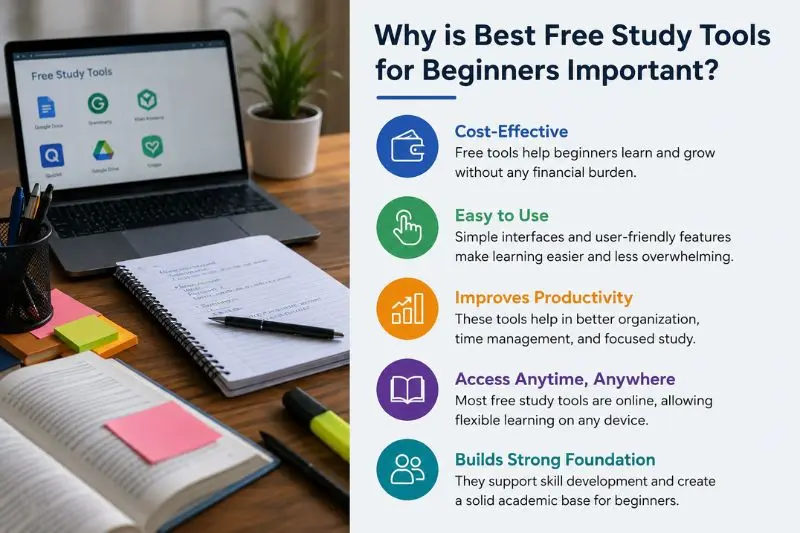
They improve organization
Keeping notes, assignments, and schedules in one place prevents confusion and saves time. Organized learners are less likely to miss deadlines or forget important topics.
They increase productivity
Study tools reduce unnecessary distractions by helping learners focus on specific tasks. Many include reminders, timers, and daily planning features that encourage consistent study habits.
They support better memory
Flashcards, quizzes, and spaced repetition techniques improve long-term memory by encouraging regular review instead of last-minute cramming.
They make studying more flexible
Since many tools synchronize across devices, students can continue learning whether they are at home, in school, or traveling.
They encourage independent learning
Beginners develop confidence when they can explore lessons, organize resources, and track their own progress without depending entirely on teachers.
They reduce costs
Educational software can be expensive, especially for students. Free alternatives provide valuable features without affecting the learner’s budget.
They simplify collaboration
Group projects become easier when everyone can share documents, edit notes together, and communicate using cloud-based platforms.
They help build consistent habits
Many learners struggle because they study irregularly. Productivity tools encourage daily practice, helping students build routines that lead to long-term success.
A simple example shows their value. Imagine a student preparing for final exams. Instead of writing scattered notes on paper, they organize subjects in a note-taking app, schedule revision sessions using a digital calendar, create flashcards for difficult definitions, and use a focus timer to avoid distractions. This organized approach improves both confidence and learning efficiency.
The Best Free Study Tools for Beginners are not magic solutions, but they make effective study habits much easier to develop. When combined with discipline and regular practice, these tools can significantly improve academic performance and make learning a more enjoyable experience.
Detailed Step-by-Step Guide
Choosing the Best Free Study Tools for Beginners is only the first step. The real improvement comes from using them consistently and creating a study routine that supports your learning goals. Follow these practical steps to build an effective and organized study system.
Step 1: Define Your Learning Goals
Before downloading any study tool, decide what you want to achieve.
Ask yourself questions such as:
- Are you preparing for exams?
- Do you want to improve your English?
- Are you learning a new skill?
- Do you need better time management?
- Do you want to organize your notes?
Clear goals make it easier to choose the right tools instead of installing dozens of unnecessary apps.
Step 2: Select a Reliable Note-Taking Tool
Good notes are the foundation of successful learning.
Choose a free note-taking application that allows you to:
- Create subject-wise notebooks
- Add headings and bullet points
- Insert images when needed
- Search your notes quickly
- Access your notes on multiple devices
Keep your notes simple and organized. Instead of writing long paragraphs, use short points and keywords that are easy to revise later.
Step 3: Create a Daily Study Schedule
A study schedule helps you stay consistent.
Plan your day by dividing study time into smaller sessions.
For example:
- Review yesterday’s lesson.
- Learn one new topic.
- Practice questions.
- Revise important notes.
- Test yourself.
Even one hour of focused learning every day is better than studying for many hours only before exams.
Step 4: Use Flashcards for Better Memory
Flashcards are excellent for remembering facts, formulas, vocabulary, dates, and definitions.
Write one question on one side and the answer on the other.
Review difficult cards more frequently than easy ones.
This method strengthens long-term memory and reduces forgetting.
Step 5: Learn with Videos and Interactive Lessons
Reading alone may become boring.
Mix your learning with educational videos, interactive lessons, quizzes, and practice exercises.
Watching visual explanations often makes difficult concepts easier to understand.
After finishing a lesson, summarize what you learned in your own words.
Step 6: Organize Your Study Materials
Many beginners waste time searching for files.
Create folders such as:
- English
- Mathematics
- Science
- History
- Practice Tests
- Assignments
- Revision Notes
A well-organized folder system saves valuable study time.
Step 7: Practice Active Learning
Avoid reading passively.
Instead:
- Solve practice questions.
- Explain topics aloud.
- Teach someone else.
- Write summaries.
- Create mind maps.
- Take short quizzes.
Active learning helps information stay in your memory much longer.
Step 8: Track Your Progress
Keep a record of completed topics.
A simple checklist can include:
- Completed chapters
- Practice tests
- Revision sessions
- Weak topics
- Strong topics
Tracking progress increases motivation because you can clearly see your improvement.
Step 9: Eliminate Distractions
Even the best study tools cannot help if you are constantly distracted.
During study time:
- Silence unnecessary notifications.
- Keep social media closed.
- Study in a quiet place.
- Use focus timers.
- Keep only required study materials nearby.
Small changes in your environment can greatly improve concentration.
Step 10: Revise Regularly
Learning without revision leads to forgetting.
Review your notes:
- After one day
- After one week
- After one month
This simple revision cycle strengthens long-term understanding.
Benefits of Best Free Study Tools for Beginners

Using the Best Free Study Tools for Beginners offers many advantages beyond simply saving money.
Some of the biggest benefits include:
- Completely free for most learners.
- Easy to use with little training.
- Available on computers and smartphones.
- Improve study organization.
- Increase daily productivity.
- Encourage consistent study habits.
- Support independent learning.
- Make revision faster.
- Improve memory through flashcards and quizzes.
- Help manage assignments effectively.
- Reduce paper usage.
- Allow cloud backup of notes.
- Support teamwork and collaboration.
- Improve time management.
- Make studying more engaging.
- Help learners track progress.
- Reduce stress before exams.
- Save valuable study time.
- Increase confidence during preparation.
- Build long-term learning habits.
Students who use organized study systems often spend less time searching for materials and more time actually learning.
Disadvantages / Risks
Although the Best Free Study Tools for Beginners are extremely useful, they also have a few limitations.
Some possible disadvantages include:
- Free versions may have limited features.
- Too many apps can become confusing.
- Internet access is required for some tools.
- Cloud services may have storage limits.
- Notifications may become distracting.
- Poor organization reduces their effectiveness.
- Beginners may spend too much time customizing apps instead of studying.
- Some platforms display advertisements.
- Device problems may temporarily limit access.
- Relying only on digital tools without practicing can reduce learning effectiveness.
Fortunately, most of these risks can be avoided by selecting only a few reliable tools and using them consistently instead of switching between multiple platforms.
Common Mistakes to Avoid
Even when using the Best Free Study Tools for Beginners, many learners make mistakes that reduce their effectiveness. Avoiding these habits will help you get better results.
Using Too Many Study Tools
Installing every popular app can make studying more confusing. Choose only a few tools that meet your needs and learn how to use them well.
Ignoring a Study Schedule
Having great study tools is not enough if you study only when you feel motivated. Create a daily routine and stick to it.
Taking Unorganized Notes
Writing random notes without headings or categories makes revision difficult. Keep your notes neat, clear, and easy to search.
Depending Only on Videos
Watching educational videos is helpful, but real learning happens when you practice, write summaries, and solve questions.
Skipping Revision
Many beginners study a topic once and never review it again. Regular revision strengthens memory and improves exam performance.
Not Tracking Progress
Without checking your progress, it is difficult to know which topics need more attention. Use checklists or progress trackers to monitor your improvement.
Studying in a Distracting Environment
Noise, social media, and constant notifications reduce concentration. Create a quiet study space and stay focused during each session.
Forgetting to Practice
Reading notes repeatedly is less effective than solving exercises, taking quizzes, and applying what you have learned.
FAQs
1. What are the best free study tools for beginners?
The best free study tools include note-taking apps, flashcard platforms, task managers, focus timers, online learning websites, cloud storage services, and digital calendars. The right combination depends on your learning goals and study style.
2. Are free study tools enough for exam preparation?
Yes. Most beginners can prepare effectively using free study tools. Success depends more on regular practice, revision, and discipline than on expensive software.
3. Can I use these study tools on my smartphone?
Most free study tools work on smartphones, tablets, and computers. This allows you to continue studying wherever you are and keep your learning materials synchronized across devices.
4. How many study tools should a beginner use?
Beginners should start with three to five essential tools. For example, one note-taking app, one flashcard tool, one calendar, one focus timer, and one cloud storage service are usually enough.
5. Do free study tools require an internet connection?
Some features require internet access, especially cloud synchronization. However, many tools also allow offline access to notes and downloaded study materials.
6. How can I study more effectively using free tools?
Set clear goals, create a study schedule, organize your notes, practice active learning, revise regularly, track your progress, and stay consistent. Free tools work best when combined with good study habits.
Expert Tips & Bonus Points
Improve your learning experience with these practical tips:
- Start with one or two study tools before adding more.
- Keep your digital files organized into subject folders.
- Review your notes at the end of every week.
- Use flashcards for definitions, formulas, and vocabulary.
- Set small daily learning goals instead of large weekly targets.
- Take short breaks after every focused study session.
- Practice with quizzes instead of only reading notes.
- Remove unnecessary apps that distract you.
- Back up important study materials regularly.
- Use a calendar to plan assignments and exam dates.
- Focus on understanding concepts rather than memorizing everything.
- Celebrate small achievements to stay motivated.
- Continue improving your study system as your learning needs grow.
Conclusion
Choosing the Best Free Study Tools for Beginners is one of the smartest decisions any learner can make. In today’s digital world, quality education is no longer limited to expensive software or paid subscriptions. With the right combination of free study tools, beginners can organize their learning, improve productivity, strengthen memory, and develop study habits that lead to long-term success. Whether you are a school student, college learner, preparing for competitive exams, or learning a new skill independently, free study resources can make your educational journey smoother and more effective.
One of the greatest advantages of these tools is their accessibility. Most are available across multiple devices, allowing you to study whenever and wherever it is convenient. You can take notes during class, review flashcards while traveling, organize assignments from your laptop, and revise important topics from your smartphone. This flexibility helps learners make better use of their time and maintain consistent progress without needing expensive equipment or premium services.
However, simply downloading study tools is not enough. Their true value comes from using them consistently and purposefully. Creating a realistic study schedule, organizing notes properly, reviewing lessons regularly, and practicing active learning techniques are habits that maximize the benefits of these free resources. Instead of relying on last-minute cramming, students should build a routine that encourages gradual improvement every day. Small, consistent efforts often produce much better results than occasional long study sessions.
It is also important to remember that every learner is different. Some students understand concepts better through visual content, while others prefer reading, writing, or solving practice questions. The Best Free Study Tools for Beginners allow you to customize your learning experience according to your personal preferences. As your skills improve, you can continue refining your study system by adding new tools that support your academic goals without making your routine overly complicated.
Another key factor in successful learning is maintaining balance. Technology should support your education rather than become a distraction. Limiting unnecessary notifications, avoiding multitasking, and focusing on one task at a time can significantly improve concentration and retention. Combining digital tools with healthy habits such as taking regular breaks, getting enough sleep, staying physically active, and maintaining a positive mindset creates a stronger foundation for academic success.
Ultimately, success is not determined by the number of study tools you use but by how effectively you use them. A small collection of reliable free resources, combined with dedication, discipline, and regular practice, can produce outstanding results. Start with the basics, remain consistent, evaluate your progress frequently, and continue improving your study habits over time. By making the most of the Best Free Study Tools for Beginners, you can study smarter, stay motivated, achieve better academic performance, and build lifelong learning skills that will benefit you in every stage of your educational and professional journey.