
Introduction
Every student dreams of studying less while achieving better grades. However, success in academics is not determined by the number of hours spent with books. Instead, it depends on using effective study techniques for students that improve understanding, strengthen memory, and increase productivity. Many learners spend countless hours reading the same material repeatedly without seeing significant improvement because they rely on inefficient study habits.
Learning is a skill that can be improved with the right approach. Whether you are preparing for school exams, college entrance tests, university assignments, or professional certifications, developing strong study habits can make a remarkable difference. Effective study methods help students stay organized, reduce stress, manage time wisely, and retain information for a longer period.
In today’s fast-paced educational environment, distractions are everywhere. Social media, entertainment, and poor time management often make studying more difficult than necessary. Fortunately, adopting proven study strategies can help students overcome these challenges while making learning more enjoyable and rewarding.
This comprehensive guide explores the most effective study techniques for students, explains why they matter, provides practical step-by-step methods, highlights common mistakes, answers frequently asked questions, and shares expert tips that can help learners perform at their best. Whether you are a beginner or an experienced student looking to improve your academic performance, these strategies can help you study smarter instead of harder.
What is Effective Study Techniques for Students?
Effective study techniques for students are practical learning methods that help individuals understand, remember, and apply information more efficiently. These techniques are based on educational research and focus on improving concentration, memory, organization, and critical thinking rather than simply increasing study hours.
Instead of memorizing information without understanding it, effective study techniques encourage active learning. Students interact with the material through note-taking, self-testing, summarizing, problem-solving, and reviewing concepts at regular intervals.
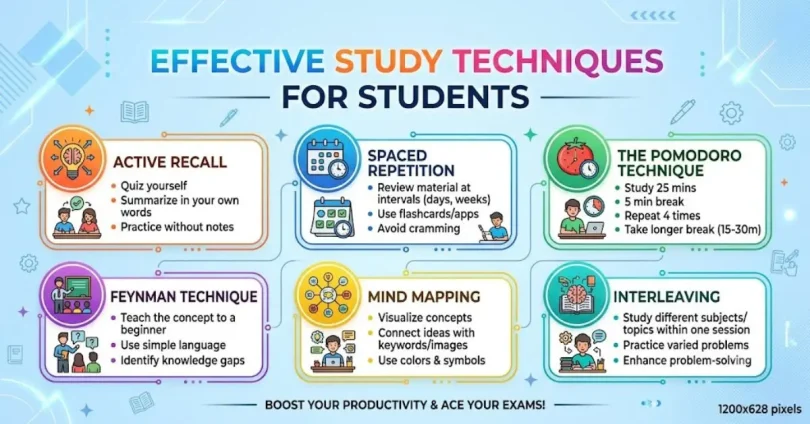
Some popular study techniques include:
- Active recall
- Spaced repetition
- Time management
- Mind mapping
- Practice testing
- Goal setting
- Organized note-taking
- Group discussions
These methods work together to improve learning outcomes and build confidence before examinations.
Why is Effective Study Techniques for Students Important?
Good study habits provide benefits that extend beyond classroom performance. Students who develop effective learning strategies often become better problem-solvers, communicators, and independent learners.
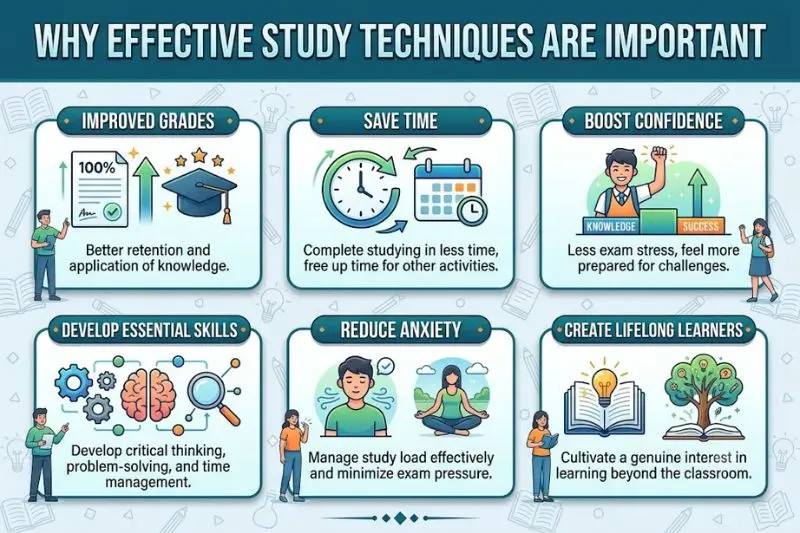
Here are some reasons why these techniques are important:
- Improve memory retention
- Increase academic performance
- Reduce exam anxiety
- Boost confidence
- Save valuable study time
- Improve concentration
- Encourage lifelong learning
- Develop better organizational skills
Rather than relying on last-minute cramming, students who follow structured study plans can absorb information gradually and remember it for much longer.
Detailed Step-by-Step Guide
Step 1: Set Clear Learning Goals
Every successful study session begins with a clear objective.
Instead of saying:
“I’ll study science today.”
Try:
“I will complete Chapter 5, solve 20 practice questions, and review my notes.”
Specific goals help maintain motivation and make progress measurable.
Tips
- Break large tasks into smaller goals.
- Use daily and weekly study plans.
- Celebrate completing each milestone.
Step 2: Create a Dedicated Study Environment
Your surroundings significantly influence your concentration.
Choose a study area that is:
- Quiet
- Comfortable
- Well-lit
- Organized
- Free from unnecessary distractions
Keep only the materials you need on your desk.
Avoid studying on your bed, as it often reduces alertness and productivity.
Step 3: Follow a Study Schedule
Consistency produces better results than occasional long study sessions.
Create a timetable that includes:
- Study time
- Homework
- Revision
- Breaks
- Leisure activities
Studying at the same time each day helps build a productive routine.
Step 4: Use Active Recall
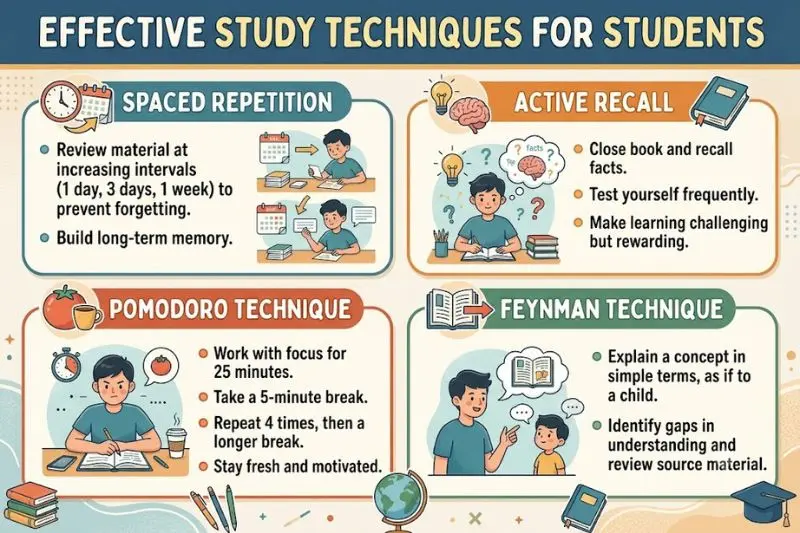
Active recall is one of the most powerful learning methods.
Instead of repeatedly reading notes, close your book and ask yourself questions.
For example:
- What did I just learn?
- Can I explain this concept?
- Can I solve this problem without looking?
This technique strengthens long-term memory much better than passive reading.
Step 5: Practice Spaced Repetition
Review information over increasing intervals instead of studying everything at once.
A simple schedule could be:
- Day 1
- Day 3
- Day 7
- Day 14
- Day 30
This method helps prevent forgetting and improves long-term retention.
Step 6: Take Effective Notes
Good notes make revision much easier.
Popular note-taking methods include:
- Cornell Method
- Outline Method
- Mind Mapping
- Chart Method
Use headings, keywords, diagrams, and summaries instead of writing every sentence from the textbook.
Step 7: Practice with Questions
Reading alone is not enough.
Solve:
- Past papers
- Practice quizzes
- Sample exams
- Workbook exercises
Testing yourself identifies weak areas before the actual examination.
Step 8: Teach Someone Else
If you can explain a topic clearly, you probably understand it well.
Teach:
- Friends
- Family members
- Classmates
Even explaining concepts aloud to yourself improves understanding.
Step 9: Manage Your Time Wisely
Good time management prevents stress and improves productivity.
Try the Pomodoro Technique:
- Study for 25 minutes.
- Take a 5-minute break.
- Repeat four times.
- Take a longer break.
Short study sessions often maintain focus better than several uninterrupted hours.
Step 10: Minimize Distractions
Modern distractions reduce learning efficiency.
During study time:
- Silence your phone.
- Turn off unnecessary notifications.
- Close unrelated browser tabs.
- Inform family members that you are studying.
Focused attention leads to faster learning.
Step 11: Maintain a Healthy Lifestyle
Your brain performs best when your body is healthy.
Remember to:
- Sleep 7–9 hours.
- Drink enough water.
- Exercise regularly.
- Eat balanced meals.
- Avoid excessive caffeine.
Healthy habits support better concentration and memory.
Step 12: Review Regularly
Revision should become a habit rather than an emergency before exams.
Weekly reviews help:
- Refresh memory
- Identify weak areas
- Strengthen understanding
- Reduce exam pressure
Regular revision is one of the most effective study techniques for students because it reinforces learning over time.
Benefits of Effective Study Techniques for Students
Using proper study methods offers numerous advantages.
- Improves concentration during study sessions.
- Enhances long-term memory.
- Builds self-confidence.
- Reduces procrastination.
- Makes learning more enjoyable.
- Improves exam performance.
- Saves valuable time.
- Encourages independent learning.
- Develops discipline.
- Reduces academic stress.
- Increases productivity.
- Supports lifelong learning skills.
- Helps students stay organized.
- Improves critical thinking.
- Makes revision more efficient.
Disadvantages / Risks
Although study techniques are beneficial, some challenges may arise if they are applied incorrectly.
- Using too many techniques at once can become overwhelming.
- Strict schedules may feel difficult initially.
- Poor planning can reduce effectiveness.
- Overstudying may lead to burnout.
- Ignoring breaks can reduce concentration.
- Relying only on memorization limits understanding.
- Comparing study methods with others may reduce confidence.
The solution is to experiment and find techniques that match your learning style.
Common Mistakes to Avoid
Many students unknowingly reduce their learning efficiency by making avoidable mistakes.
1. Cramming Before Exams
Studying everything the night before rarely leads to long-term retention.
Instead, review material consistently.
2. Reading Without Testing Yourself
Passive reading creates the illusion of learning.
Always test your knowledge through questions or summaries.
3. Ignoring Difficult Subjects
Avoiding challenging topics only makes them harder later.
Study difficult subjects first while your energy is highest.
4. Multitasking
Watching videos, texting friends, and studying simultaneously reduces concentration.
Focus on one task at a time.
5. Skipping Breaks
Continuous studying reduces mental performance.
Regular breaks help maintain focus.
6. Poor Sleep Habits
Lack of sleep negatively affects memory and concentration.
Quality sleep is part of successful studying.
7. Disorganized Notes
Messy notes waste valuable revision time.
Keep notebooks organized with headings and summaries.
8. Unrealistic Goals
Trying to study ten chapters in one day often leads to disappointment.
Set achievable daily targets.
FAQs
What are the most effective study techniques for students?
The most effective methods include active recall, spaced repetition, practice testing, time management, note-taking, teaching others, and regular revision. Combining several of these strategies usually produces the best results.
How many hours should students study each day?
There is no universal answer. Quality matters more than quantity. Most students benefit from two to five focused study hours depending on their educational level and workload
Is studying every day better than cramming?
Yes. Daily study sessions improve long-term memory, reduce stress, and make exam preparation much easier than last-minute cramming
How can I stay focused while studying?
Choose a quiet environment, remove distractions, set clear goals, use short study sessions with breaks, and avoid checking your phone frequently.
Should students study alone or in groups?
Both methods have advantages. Individual study improves concentration, while group discussions help clarify difficult concepts and encourage active learning. A balanced combination often works best
What is active recall?
Active recall involves retrieving information from memory without looking at your notes. This strengthens memory much more effectively than simply rereading textbooks.
Why is spaced repetition effective?
Spaced repetition reviews information over increasing intervals. This process strengthens memory and reduces forgetting, making revision more efficient.
How can students overcome procrastination?
Break tasks into smaller goals, create a study schedule, remove distractions, reward yourself after completing tasks, and start with just five minutes of focused work to build momentum
Expert Tips & Bonus Points
Students who consistently achieve excellent academic results often follow these additional practices.
- Study your most difficult subject when your energy is highest.
- Review class notes within 24 hours.
- Create summary sheets before exams.
- Use flashcards for definitions and formulas.
- Practice writing answers under exam conditions.
- Keep a progress tracker.
- Reward yourself after reaching study goals.
- Replace perfectionism with consistency.
- Stay physically active to improve brain function.
- Ask teachers whenever concepts remain unclear.
- Revise weak topics more frequently than familiar ones.
- Keep your study materials organized throughout the year.
- Avoid comparing your learning speed with others.
- Focus on understanding concepts instead of memorizing every sentence.
- Develop a growth mindset by viewing mistakes as learning opportunities.
Remember that no single method works perfectly for everyone. Experiment with different techniques and refine your study routine over time.
Conclusion
Academic success is not reserved for naturally gifted students. In reality, consistent effort combined with effective study techniques for students can dramatically improve learning outcomes for almost anyone. Building productive study habits requires patience, discipline, and a willingness to adapt, but the long-term rewards are well worth the effort. Instead of relying on lengthy study sessions or last-minute cramming, students benefit far more from structured routines, active learning, regular revision, and healthy lifestyle choices.
The techniques discussed in this guide—from setting clear goals and creating a distraction-free study space to practicing active recall, spaced repetition, and self-testing—provide a practical framework for studying smarter. These methods not only enhance memory and understanding but also reduce stress and increase confidence during examinations. Equally important is recognizing and avoiding common mistakes such as multitasking, skipping sleep, or relying solely on passive reading.
Remember that improvement does not happen overnight. Start by introducing one or two new strategies into your daily routine, then gradually build a study system that matches your learning style and academic needs. Small, consistent improvements often produce the greatest long-term results. By making effective study techniques for students a regular part of your education, you can develop stronger learning skills, achieve better grades, and build habits that will support success throughout school, university, and your future career.