
Introduction
Have you ever studied for hours only to forget most of the information a few days later? You’re not alone. Many students, professionals, and lifelong learners struggle to remember important details despite putting in significant effort. The good news is that memory is not a fixed ability. With the right techniques and habits, anyone can strengthen their memory and improve information retention over time.
Learning how to improve memory and retention is essential in today’s fast-paced world. Whether you’re preparing for exams, learning a new language, mastering workplace skills, or simply trying to remember everyday tasks, effective memory strategies can make learning easier and less stressful.
Memory works best when the brain receives meaningful information through active engagement, regular practice, proper nutrition, and adequate rest. Small daily habits often have a much bigger impact than long, exhausting study sessions. Fortunately, improving memory doesn’t require expensive tools or special talent. Instead, it depends on using scientifically supported methods consistently.
In this comprehensive guide, you’ll discover practical techniques to strengthen your memory, understand why retention matters, avoid common mistakes, and develop habits that support long-term learning. By applying these strategies consistently, you’ll be able to remember information more effectively, recall it faster, and continue learning with greater confidence.
What is How to Improve Memory and Retention?

Memory is the brain’s ability to receive, store, and retrieve information whenever it is needed. Retention refers to how well that information remains stored over time without being forgotten.
Learning how to improve memory and retention means developing habits and techniques that help your brain process information more efficiently and remember it for longer periods.
Memory generally involves three important stages:
- Encoding information
- Storing information
- Retrieving information later
If any of these stages are weak, remembering becomes difficult. Improving each stage leads to stronger overall memory performance.
Why is How to Improve Memory and Retention Important?

Strong memory benefits every area of life.
Whether you’re studying, working, or managing daily responsibilities, remembering information accurately saves time and reduces frustration.
Improving memory helps you:
- Learn new skills faster
- Perform better in school and college
- Increase workplace productivity
- Build confidence
- Reduce stress before exams
- Improve decision-making
- Remember names, dates, and appointments
- Strengthen problem-solving abilities
- Support healthy brain aging
Better retention means spending less time relearning forgotten information.
Detailed Step-by-Step Guide
Step 1: Understand How Your Brain Learns
Before memorizing information, understand it first.
Meaningful learning creates stronger brain connections than simple repetition. Instead of trying to memorize every word, focus on understanding concepts.
For example:
Rather than memorizing a scientific definition, understand why the process happens and how it works.
Step 2: Practice Active Recall
Active recall is one of the most effective learning techniques.
Instead of rereading notes repeatedly, close your notebook and try to remember everything without looking.
Examples include:
- Answering questions from memory
- Using flashcards
- Teaching someone else
- Writing summaries without notes
This forces your brain to retrieve information, making memories much stronger.
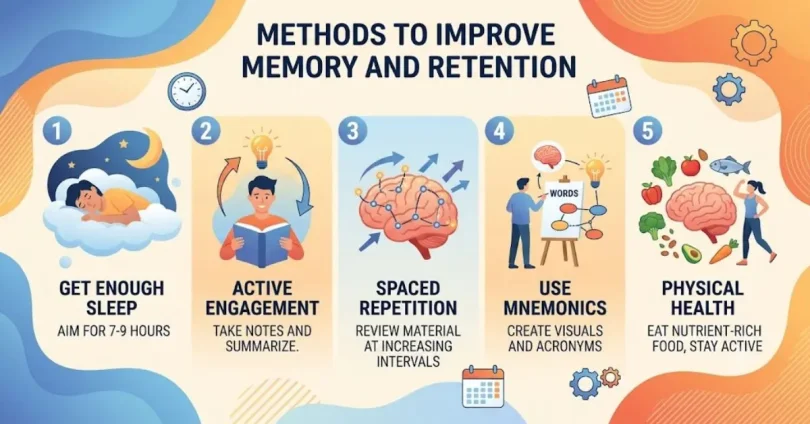
Step 3: Use Spaced Repetition
Review information at increasing intervals instead of studying everything at once.
A simple schedule might be:
- Day 1
- Day 3
- Day 7
- Day 14
- Day 30
Each review strengthens long-term retention.
Step 4: Break Information into Smaller Chunks
The brain remembers smaller pieces of information much better.
Instead of memorizing:
9237846512
Break it into:
923-784-6512
This technique, known as chunking, reduces mental overload.
Apply chunking to:
- Vocabulary
- Historical dates
- Phone numbers
- Formulas
- Study notes
Step 5: Connect New Information to Existing Knowledge
Your brain remembers information better when it connects with something already familiar.
For example:
Learning about planets?
Relate them to objects you already know.
Learning a new language?
Associate unfamiliar words with similar-sounding native words.
The more meaningful the connection, the easier the recall.
Step 6: Get Enough Sleep
Sleep is essential for memory consolidation.
During sleep, the brain organizes and stores information learned throughout the day.
Adults generally need:
- 7–9 hours of quality sleep
Poor sleep often leads to:
- Forgetfulness
- Difficulty concentrating
- Slower learning
Never underestimate the importance of consistent sleep.
Step 7: Exercise Regularly
Physical activity increases blood flow to the brain.
Exercise also supports the growth of new brain cells and improves concentration.
Good options include:
- Walking
- Cycling
- Swimming
- Yoga
- Strength training
Aim for at least 30 minutes most days of the week.
Step 8: Eat Brain-Healthy Foods
Nutrition plays a major role in memory.
Include foods such as:
- Blueberries
- Walnuts
- Almonds
- Eggs
- Salmon
- Leafy vegetables
- Pumpkin seeds
- Avocados
- Whole grains
Stay hydrated throughout the day because even mild dehydration can reduce concentration.
Step 9: Reduce Multitasking
Many people believe multitasking improves productivity.
In reality, switching between tasks weakens focus and reduces memory formation.
Instead:
- Complete one task at a time.
- Remove distractions.
- Silence unnecessary notifications.
Focused attention creates stronger memories.
Step 10: Teach Others
Teaching is one of the fastest ways to remember information.
When explaining a topic, you identify knowledge gaps and strengthen understanding.
Try teaching:
- Friends
- Family members
- Classmates
- Colleagues
Even explaining concepts aloud to yourself can improve retention.
Step 11: Take Regular Breaks
Long study sessions reduce concentration.
Use techniques like:
- Study for 50 minutes
- Break for 10 minutes
Or
- 25 minutes of focused work
- 5-minute break
Short breaks refresh the brain and improve long-term learning.
Step 12: Manage Stress
Chronic stress negatively affects memory.
Practice stress management through:
- Deep breathing
- Meditation
- Nature walks
- Journaling
- Stretching
- Listening to calming music
A relaxed mind learns more effectively.
Step 13: Use Visualization
The brain remembers pictures better than plain text.
Visualize concepts whenever possible.
Examples include:
- Mind maps
- Diagrams
- Flowcharts
- Mental images
- Color-coded notes
Visualization makes abstract ideas easier to remember.
Step 14: Review Before Forgetting
Many people wait until exam week.
Instead, review material regularly before memory fades.
Frequent review requires much less effort than relearning forgotten material.
Benefits of How to Improve Memory and Retention
Improving memory provides advantages in both personal and professional life.
Benefits include:
- Faster learning
- Better academic performance
- Higher workplace productivity
- Greater confidence
- Improved concentration
- Reduced exam anxiety
- Better decision-making
- Enhanced creativity
- Stronger communication skills
- Easier problem-solving
- Better long-term brain health
- Increased efficiency in daily tasks
Disadvantages / Risks
Although improving memory is highly beneficial, certain approaches can create problems if used incorrectly.
Potential risks include:
- Overloading the brain with excessive study sessions
- Depending only on memorization without understanding
- Ignoring sleep to study longer
- Spending too much time reviewing instead of practicing
- Becoming frustrated by unrealistic expectations
- Using ineffective learning techniques repeatedly
- Neglecting physical health while focusing only on studying
Balance is essential for lasting results.
Common Mistakes to Avoid
Many learners unknowingly reduce their memory performance through poor habits.
Avoid these common mistakes:
Studying Without Focus
Distractions reduce memory formation.
Choose a quiet learning environment.
Cramming Before Exams
Last-minute studying creates temporary memory rather than long-term retention.
Skipping Sleep
Sleep deprivation weakens memory significantly.
Passive Reading
Reading repeatedly without testing yourself produces weaker learning.
Ignoring Practice
Knowledge improves through application.
Solve problems, answer questions, and complete exercises regularly.
Not Reviewing Material
Without review, forgetting happens naturally.
Poor Nutrition
An unhealthy diet can reduce concentration and cognitive performance.
Giving Up Too Soon
Memory improvement takes consistent practice over weeks and months.
FAQs
How long does it take to improve memory and retention?
Most people notice improvements within a few weeks of consistent practice. Long-term benefits develop over several months of healthy habits and regular review.
Does age affect memory improvement?
Yes, memory naturally changes with age, but people of all ages can strengthen their memory through exercise, mental stimulation, quality sleep, and healthy nutrition.
Which study method improves memory the most?
Active recall combined with spaced repetition is widely considered one of the most effective learning methods for long-term retention
Can exercise really improve memory?
Yes. Regular physical activity increases blood circulation to the brain, supports cognitive function, and improves concentration and memory
Are memory supplements necessary?
Most healthy individuals benefit more from proper sleep, balanced nutrition, exercise, and effective study techniques than from supplements. Always consult a healthcare professional before using supplements.
Why do I forget information so quickly?
Common reasons include stress, lack of sleep, distractions, passive studying, insufficient review, and trying to learn too much at once.
Is reading repeatedly enough to remember information?
No. Repeated reading alone is much less effective than testing yourself, summarizing concepts, and practicing active recall.
Can meditation improve memory?
Yes. Regular meditation improves attention, reduces stress, and increases mental clarity, which can support stronger memory formation.
Expert Tips & Bonus Points
Experts recommend combining several techniques instead of relying on only one.
Helpful tips include:
- Study at the same time every day.
- Write notes by hand when possible.
- Use colorful diagrams and mind maps.
- Stay physically active.
- Drink enough water daily.
- Learn difficult subjects during your most productive hours.
- Avoid excessive screen distractions while studying.
- Quiz yourself frequently.
- Explain concepts aloud.
- Set realistic learning goals.
- Maintain a consistent sleep schedule.
- Celebrate small learning achievements to stay motivated.
- Keep a positive mindset because confidence improves learning efficiency.
Remember that consistency always beats intensity. Small improvements every day lead to remarkable memory gains over time.
Conclusion
Learning how to improve memory and retention is one of the most valuable investments you can make in your personal and professional growth. A stronger memory not only helps you perform better in exams and at work but also boosts confidence, improves decision-making, and makes everyday life more organized. The encouraging news is that memory is a skill that can be developed through regular practice, healthy habits, and effective learning techniques rather than something determined solely by natural ability.
The strategies covered in this guide—including active recall, spaced repetition, chunking, visualization, regular exercise, quality sleep, proper nutrition, stress management, and consistent review—work together to strengthen the brain’s ability to store and retrieve information. While there is no instant solution, steady effort produces lasting improvements. Even small changes, such as reviewing notes more effectively or getting enough sleep, can make a noticeable difference over time.
It’s also important to avoid common mistakes like cramming, multitasking, passive reading, and neglecting your physical health. By replacing these habits with smarter study methods and a balanced lifestyle, you’ll improve both learning efficiency and long-term retention.
Start with one or two techniques today and gradually build them into your daily routine. As these habits become consistent, you’ll find it easier to remember information, learn new skills, and achieve your educational, personal, and career goals with greater confidence and success.