
Introduction
The Future of AI in Education is rapidly changing how students learn and how teachers deliver knowledge. Artificial intelligence is no longer a futuristic concept—it has become an important part of modern education. From personalized learning experiences to intelligent tutoring systems and automated grading, AI is helping educational institutions improve efficiency while making learning more engaging. As technology continues to evolve, students, teachers, schools, and parents must understand how AI is shaping the future of education and what opportunities it brings.
Instead of replacing traditional teaching methods, AI enhances them by providing smarter tools that adapt to individual learning styles. Students can receive instant feedback, customized study plans, and interactive learning experiences that improve understanding and retention. Meanwhile, educators can spend less time on repetitive administrative tasks and more time guiding students through meaningful learning experiences. Although AI offers countless possibilities, it also raises important questions about privacy, ethics, and equal access to technology. Understanding both its advantages and challenges is essential for preparing for the next generation of education.
What is Future of AI in Education?
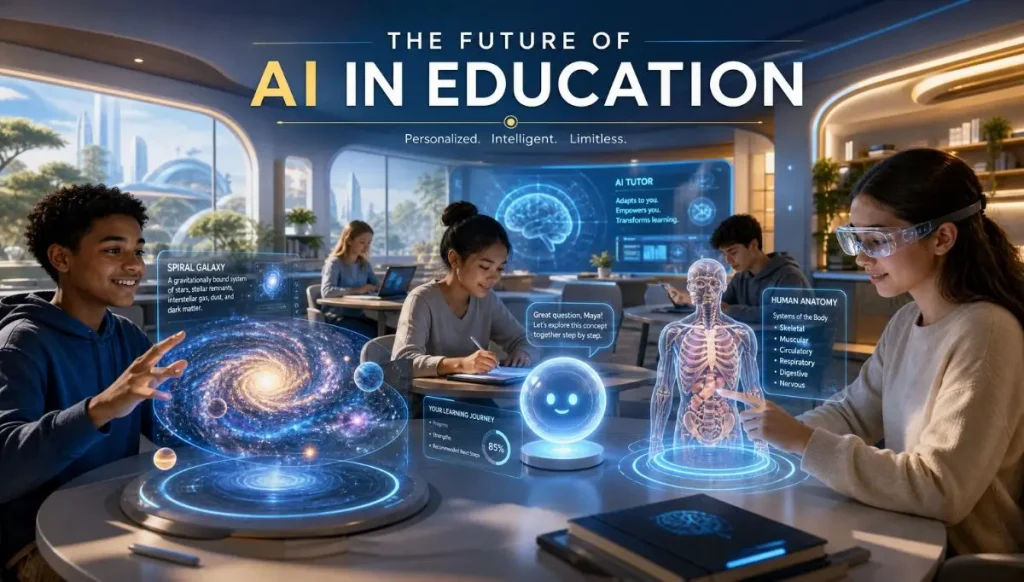
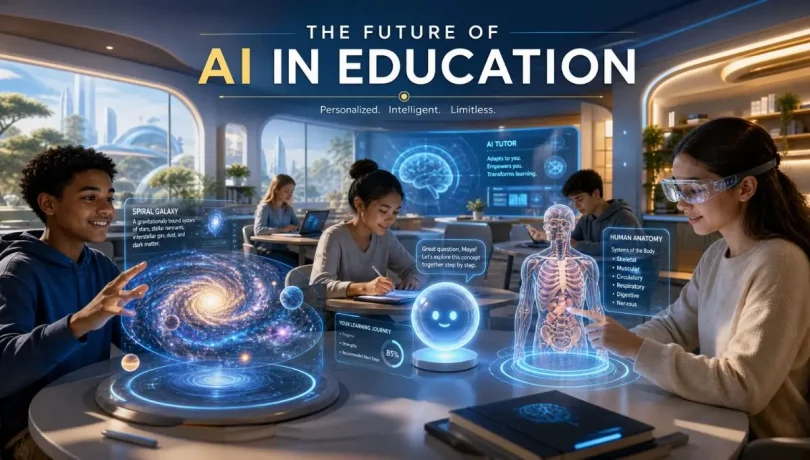
The Future of AI in Education refers to the growing integration of artificial intelligence technologies into educational environments to improve teaching, learning, assessment, and administration. AI-powered systems analyze data, recognize learning patterns, and provide personalized educational experiences that meet the unique needs of every learner.
Unlike traditional educational methods, AI can continuously adapt to a student’s performance. If a learner struggles with a topic, AI can recommend additional practice materials or explain concepts in different ways. Similarly, advanced systems can identify students who may need extra support long before poor academic performance becomes a serious concern.
Artificial intelligence in education includes a wide range of technologies, such as:
- Personalized learning platforms
- Intelligent tutoring systems
- Automated grading tools
- Virtual teaching assistants
- Speech recognition software
- Language translation tools
- Learning analytics dashboards
- Adaptive testing systems
As these technologies continue to improve, classrooms are becoming more interactive, flexible, and student-centered.
Why is Future of AI in Education Important?
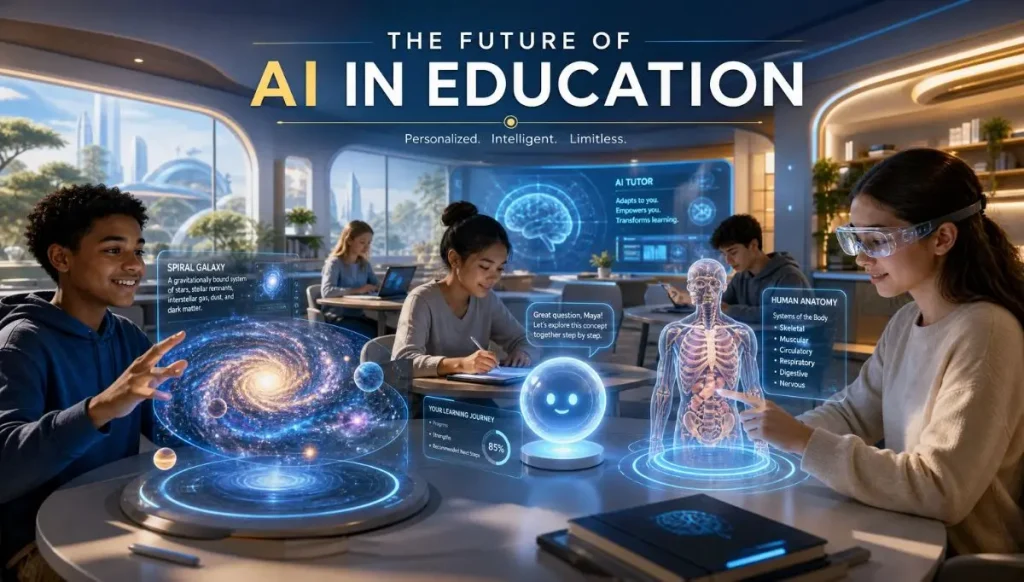
Artificial intelligence is transforming education by making learning more effective, accessible, and personalized. Every student learns differently, and traditional classrooms often struggle to meet individual learning needs. AI helps bridge this gap by creating customized learning experiences based on each student’s strengths, weaknesses, pace, and learning preferences.
Another important reason AI is becoming essential is its ability to reduce teachers’ workloads. Many administrative tasks, including grading assignments, tracking attendance, and generating performance reports, can now be automated. This allows educators to dedicate more time to lesson planning, classroom discussions, and supporting students personally.
The importance of the Future of AI in Education can be seen in several key areas:
- Delivers personalized learning experiences
- Improves student engagement through interactive content
- Provides instant feedback to learners
- Supports teachers with automated administrative tasks
- Helps identify learning gaps early
- Enhances online and remote education
- Makes quality education more accessible
- Supports students with different learning abilities
- Encourages data-driven educational decisions
- Prepares students for technology-driven careers
As educational systems continue to evolve, AI will play an increasingly significant role in helping schools improve learning outcomes while making education more inclusive and efficient.
Step-by-Step Guide to Preparing for the Future of AI in Education
Step 1: Build a Basic Understanding of AI
Before adopting AI in education, students, teachers, and school administrators should understand the fundamentals of artificial intelligence. Knowing how AI works helps users make informed decisions and use technology responsibly.
Some basic concepts to learn include:
- Machine learning
- Natural language processing
- Data analysis
- Automation
- Predictive analytics
Understanding these concepts does not require advanced technical knowledge. Even a basic awareness helps users recognize the strengths and limitations of AI-powered educational tools.
Step 2: Define Clear Learning Objectives
AI tools should always support educational goals rather than become the goal themselves. Before selecting any AI-powered platform, identify what you want to achieve.
For example, your objectives may include:
- Improving student performance
- Increasing classroom engagement
- Saving teachers’ time
- Providing personalized learning
- Enhancing online education
- Supporting students with learning difficulties
When learning objectives are clearly defined, choosing the right AI solution becomes much easier.
Step 3: Select Reliable AI Educational Tools
Not every AI tool offers the same level of quality or accuracy. Schools and individual learners should carefully evaluate educational platforms before adopting them.
Consider factors such as:
- Ease of use
- Data privacy and security
- Content accuracy
- User reviews
- Regular software updates
- Compatibility with existing learning systems
- Customer support
Choosing reliable tools helps ensure a safe and productive learning environment.
Step 4: Personalize the Learning Experience
One of the greatest strengths of AI is its ability to create personalized learning paths for every student. Instead of following the same lesson plan for everyone, AI analyzes learning behavior and recommends materials based on individual progress.
Personalized learning may include:
- Customized lesson recommendations
- Practice quizzes based on weak areas
- Adaptive difficulty levels
- Personalized revision schedules
- Interactive exercises
- Instant performance feedback
This individualized approach keeps students motivated while helping them learn at a pace that suits their abilities.
Step 5: Support Teachers with AI-Powered Automation
Artificial intelligence can significantly reduce the time teachers spend on repetitive administrative tasks. Instead of focusing on paperwork, educators can devote more attention to classroom interaction, lesson planning, and student development.
AI can assist teachers by:
- Automatically grading quizzes and assignments
- Tracking attendance
- Creating lesson plans
- Organizing classroom schedules
- Monitoring student progress
- Generating performance reports
- Recommending learning resources
For example, if a teacher has a class of 50 students, AI can quickly analyze test results and highlight students who need additional support, allowing timely intervention.
Step 6: Monitor Student Progress with Learning Analytics
One of the most valuable features of AI is its ability to analyze large amounts of learning data. Instead of relying only on exam scores, AI evaluates daily learning habits and performance trends.
Learning analytics can help identify:
- Subjects where students struggle
- Frequently repeated mistakes
- Improvement over time
- Learning speed
- Attendance patterns
- Assignment completion rates
- Student engagement levels
This information enables teachers to make informed decisions and provide personalized support before learning problems become more serious.
Step 7: Promote Ethical and Responsible AI Use
As AI becomes more common in education, ethical use becomes increasingly important. Schools should develop clear policies to ensure AI supports learning without compromising student privacy or fairness.
Important ethical practices include:
- Protecting student data
- Maintaining transparency in AI decisions
- Avoiding bias in AI systems
- Encouraging responsible technology use
- Respecting academic integrity
- Ensuring equal access to learning opportunities
Students should also understand that AI is a learning assistant, not a shortcut for avoiding independent thinking or completing assignments dishonestly.
Step 8: Keep Learning and Adapting
Artificial intelligence continues to evolve rapidly. New educational tools, teaching methods, and innovations appear every year. To fully benefit from the Future of AI in Education, both students and educators should commit to continuous learning.
Ways to stay updated include:
- Participating in professional development workshops
- Completing online certification courses
- Reading educational technology blogs and publications
- Exploring new AI-powered learning platforms
- Sharing experiences with colleagues and peers
- Practicing with emerging educational technologies
Continuous learning ensures that individuals remain prepared for future developments and can make the most of AI-powered education.
Benefits of Future of AI in Education
The Future of AI in Education offers numerous advantages that improve teaching, learning, and educational management. As AI technologies become more advanced, they create opportunities for students to receive a more personalized education while helping teachers become more effective.
Some of the major benefits include:
- Personalized learning experiences for every student
- Faster and more accurate feedback on assignments
- Reduced workload for teachers
- Improved classroom productivity
- Better student engagement through interactive learning
- Support for students with disabilities
- More efficient lesson planning
- Early identification of learning difficulties
- Flexible learning schedules
- Improved online and remote education
- Data-driven educational decisions
- Increased accessibility to quality education
- Better language learning support
- Enhanced collaboration between teachers and students
- Preparation for future technology-driven careers
These advantages help create a learning environment where students can achieve their full potential while teachers focus on meaningful instruction rather than repetitive administrative tasks.
Disadvantages / Risks
Although AI provides many benefits, it also presents several challenges that schools and educators should carefully consider before widespread implementation.
Some potential risks include:
- High implementation and maintenance costs
- Privacy concerns related to student data
- Dependence on technology
- Reduced face-to-face interaction
- Bias in AI algorithms
- Unequal access to digital resources
- Technical failures or software errors
- Internet connectivity limitations
- Need for ongoing teacher training
- Risk of students relying too heavily on AI
These challenges do not outweigh the benefits, but they highlight the importance of using AI responsibly and balancing technology with human teaching.
Common Mistakes to Avoid
Successfully implementing AI in education requires thoughtful planning. Many schools and learners make mistakes that reduce the effectiveness of AI-powered learning.
Avoid these common mistakes:
1. Depending Completely on AI
AI should support teachers and students, not replace critical thinking, creativity, or human interaction.
2. Ignoring Data Privacy
Schools should never overlook the importance of protecting student information. Always choose platforms with strong privacy and security measures.
3. Choosing AI Tools Without Research
Not every AI platform offers reliable educational content. Compare features, reviews, security, and usability before making a decision.
4. Failing to Train Teachers
Even the best AI tools cannot produce good results if educators are unfamiliar with how to use them effectively.
5. Expecting Immediate Results
Improving educational outcomes takes time. AI should be viewed as a long-term investment rather than a quick solution.
6. Neglecting Human Interaction
Technology should enhance relationships between teachers and students, not replace meaningful classroom discussions and personal guidance.
7. Ignoring Regular Updates
AI software evolves continuously. Keeping platforms updated improves performance, security, and access to new features.
8. Overlooking Student Feedback
Students are the primary users of educational technology. Their feedback helps schools identify strengths, weaknesses, and opportunities for improvement.
By avoiding these mistakes, schools and educators can successfully integrate AI into classrooms while maximizing its educational benefits.
FAQs
1. What is the future of AI in education?
The Future of AI in Education refers to the increasing use of artificial intelligence to improve teaching, learning, assessment, and school management. AI helps create personalized learning experiences, automates routine tasks, and provides valuable insights that help educators support students more effectively. As technology advances, AI is expected to become an essential part of modern classrooms.
2. Will AI replace teachers in the future?
No, AI is unlikely to replace teachers. Instead, it will serve as a powerful teaching assistant by handling repetitive tasks such as grading, attendance tracking, and lesson recommendations. Teachers provide emotional support, motivation, critical thinking guidance, and classroom management—qualities that technology cannot fully replicate.
3. How does AI improve student learning?
AI improves learning by analyzing a student’s strengths, weaknesses, and learning pace. Based on this information, it recommends personalized lessons, practice exercises, quizzes, and study materials. Students receive immediate feedback, allowing them to correct mistakes quickly and improve their understanding of difficult topics.
4. Is AI safe for students to use?
AI can be safe when educational institutions use trusted platforms with strong privacy and security measures. Schools should protect student data, follow ethical guidelines, and ensure that AI systems are transparent and fair. Parents and teachers should also educate students about the responsible use of AI technologies.
5. What skills should students develop for an AI-driven future?
Students should focus on developing both technical and soft skills to succeed in an AI-powered world. Important skills include:
- Critical thinking
- Problem-solving
- Creativity
- Communication
- Collaboration
- Digital literacy
- Adaptability
- Emotional intelligence
These skills help students work effectively alongside AI rather than depend entirely on it.
6. How can schools prepare for the future of AI in education?
Schools can prepare by investing in digital infrastructure, training teachers, introducing AI literacy programs, and establishing clear policies for responsible AI use. They should also ensure equal access to technology and regularly evaluate the effectiveness of AI-powered learning tools. A balanced approach that combines technology with quality teaching will produce the best educational outcomes.
Expert Tips & Bonus Points
To make the most of the Future of AI in Education, keep these expert recommendations in mind:
- Use AI as a learning assistant rather than a replacement for independent thinking.
- Combine AI-powered learning with traditional teaching methods for better results.
- Encourage students to verify AI-generated information using trusted educational sources.
- Choose AI tools that prioritize student privacy and data security.
- Train teachers regularly so they can confidently integrate AI into their classrooms.
- Monitor student progress continuously and adjust learning strategies when needed.
- Focus on developing creativity, communication, and critical thinking alongside technical skills.
- Introduce AI gradually so students and teachers can adapt comfortably.
- Keep exploring new educational technologies as AI continues to evolve.
- Remember that successful education will always depend on the partnership between skilled teachers, motivated students, and intelligent technology.
Conclusion
The Future of AI in Education is transforming the way knowledge is delivered, accessed, and experienced. From personalized learning paths and intelligent tutoring systems to automated administrative tasks and real-time performance analysis, AI has the potential to make education more efficient, inclusive, and engaging. It empowers teachers to spend more time inspiring students while giving learners the flexibility to study at their own pace. As educational institutions continue to embrace innovation, AI will play an increasingly important role in preparing students for a technology-driven world.
However, the successful adoption of AI requires thoughtful planning and responsible implementation. Schools must prioritize student privacy, ensure equal access to digital resources, and provide ongoing training for educators. At the same time, students should continue developing essential human skills such as creativity, critical thinking, communication, and collaboration. When artificial intelligence is used to support—not replace—quality teaching, it creates a balanced learning environment where technology and human expertise work together. By embracing innovation while maintaining strong educational values, the Future of AI in Education can help build smarter classrooms, more confident learners, and a brighter future for education worldwide.