
Introduction
Communication is one of the most valuable life skills anyone can develop. Whether you are a student, professional, entrepreneur, or someone looking to improve relationships, strong communication skills can help you express ideas clearly, solve problems effectively, and build meaningful connections. In today’s fast-changing world, success depends not only on what you know but also on how well you communicate with others.
Communication skills for personal development involve much more than speaking confidently. They include listening actively, understanding emotions, using positive body language, writing clearly, and adapting your message to different audiences. These abilities strengthen both personal and professional relationships while increasing self-confidence and emotional intelligence.
Many people believe communication is a natural talent. In reality, it is a skill that anyone can learn and improve with regular practice. Even small changes, such as maintaining eye contact, asking thoughtful questions, or listening without interrupting, can make a noticeable difference.
This guide explores the importance of communication skills for personal development, explains their core components, and provides practical strategies that beginners and intermediate learners can apply every day. By developing these skills consistently, you can become a better leader, teammate, friend, and communicator in every area of life.
What Are Communication Skills for Personal Development?
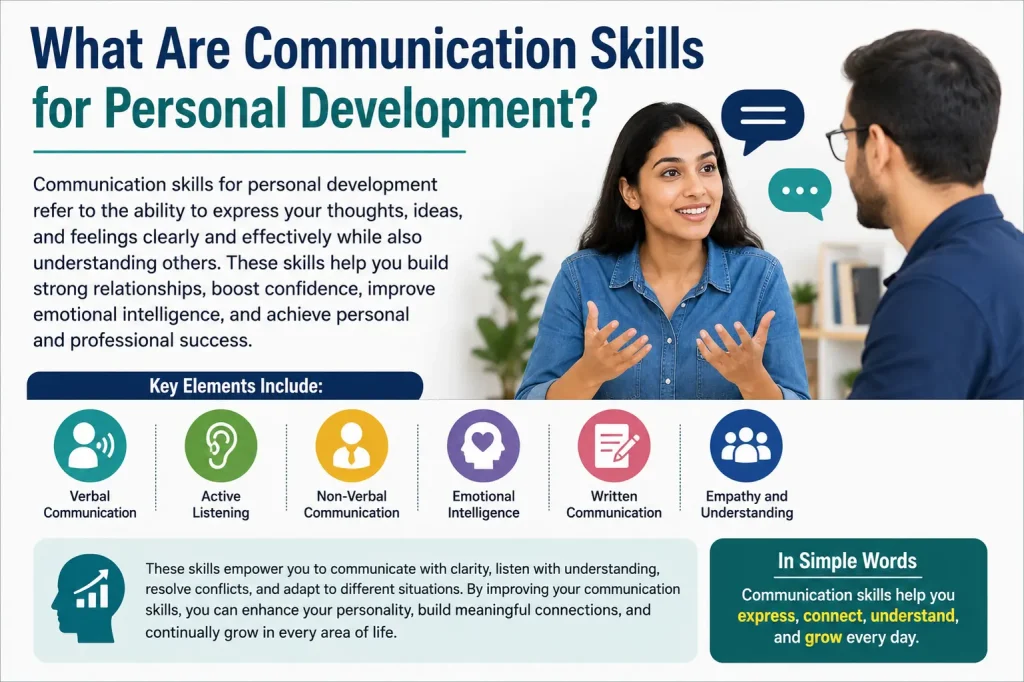
Communication skills for personal development refer to the ability to exchange information, ideas, thoughts, and emotions effectively while continuously improving your confidence, relationships, and overall personality.
These skills include both verbal and non-verbal communication. Speaking clearly is important, but understanding others through active listening, facial expressions, gestures, and empathy is equally valuable.
Personal development focuses on becoming the best version of yourself. Communication plays a central role because almost every aspect of life involves interacting with other people. From classroom discussions to workplace meetings and family conversations, effective communication creates opportunities for learning, collaboration, and growth.
Key communication skills include:
- Active listening
- Clear verbal communication
- Written communication
- Positive body language
- Emotional intelligence
- Confidence in speaking
- Public speaking
- Conflict resolution
- Empathy
- Constructive feedback
For example, imagine two employees with similar technical abilities. The employee who communicates ideas clearly, listens respectfully, and works well with colleagues is often more likely to earn promotions and leadership opportunities.
Communication skills are not limited to formal situations. Everyday conversations with family, friends, customers, and classmates also contribute to personal development. Each interaction provides an opportunity to practice patience, clarity, respect, and understanding.
As you continue developing these skills, you become more adaptable, persuasive, and confident in handling different situations. Over time, effective communication becomes a natural habit rather than a conscious effort.
Why Are Communication Skills for Personal Development Important?
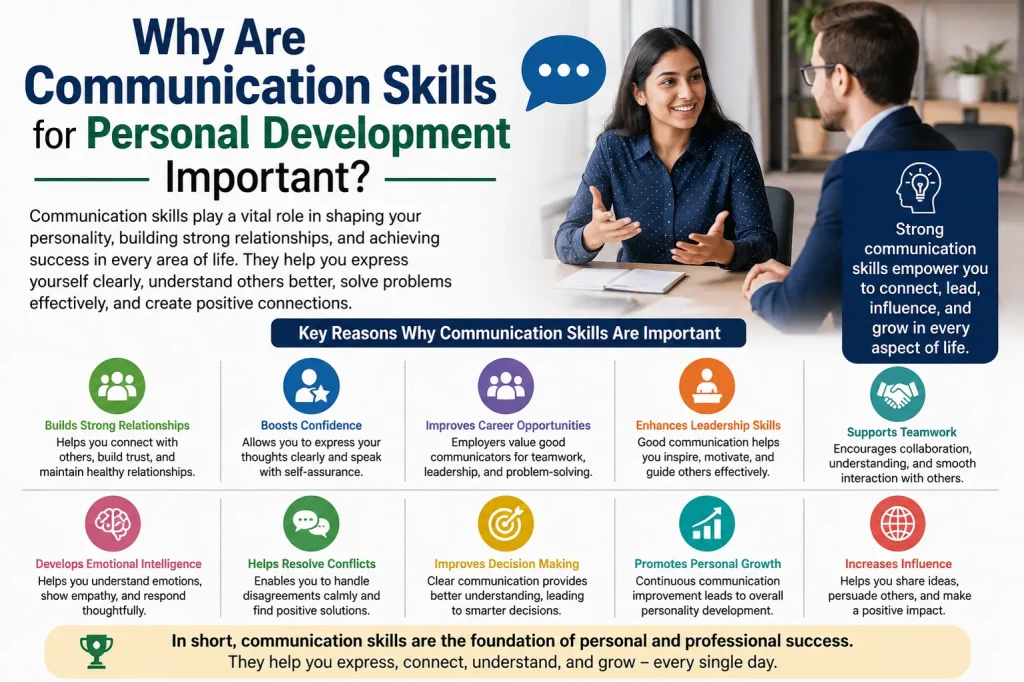
Communication skills are the foundation of personal growth because they influence nearly every aspect of daily life. From expressing your thoughts to understanding others, effective communication helps you build trust, solve problems, and create lasting relationships. Regardless of your age or profession, improving communication skills can open doors to new opportunities and increase your confidence.
One of the biggest advantages of strong communication is improved self-confidence. When you can express your ideas clearly, you are more likely to participate in discussions, speak during meetings, and share your opinions without fear. This confidence gradually reflects in your personality and helps you handle challenging situations with ease.
Communication skills also strengthen relationships. Whether you are talking with family members, friends, classmates, or colleagues, clear and respectful communication reduces misunderstandings and builds mutual trust. Good listeners often develop stronger relationships because they make others feel heard and valued.
In professional life, communication is considered one of the most desirable soft skills. Employers value individuals who can present ideas effectively, collaborate with teams, negotiate professionally, and resolve conflicts peacefully. Strong communicators often earn leadership roles because they inspire confidence and encourage teamwork.
Another important reason is emotional intelligence. Learning how to understand emotions—both your own and those of others—helps you respond thoughtfully instead of reacting impulsively. This creates healthier conversations and improves decision-making.
Furthermore, effective communication supports lifelong learning. Asking questions, seeking feedback, and participating in meaningful discussions allow you to gain new knowledge and improve continuously.
In short, communication skills are essential because they help you:
- Build stronger personal and professional relationships.
- Increase self-confidence and self-esteem.
- Improve teamwork and collaboration.
- Enhance leadership abilities.
- Solve conflicts more effectively.
- Develop emotional intelligence.
- Create better career opportunities.
- Become a more confident and positive individual.
Step-by-Step Guide to Improving Communication Skills for Personal Development
Step 1: Become an Active Listener
Great communication begins with listening rather than speaking. Active listening means paying full attention to the speaker without interrupting or thinking about your response before they finish.
To become a better listener:
- Maintain eye contact.
- Avoid distractions such as mobile phones.
- Listen without interrupting.
- Ask relevant follow-up questions.
- Summarize what you heard to confirm understanding.
For example, instead of immediately offering advice, repeat the main point by saying, “So what you’re saying is…” This simple habit reduces misunderstandings and shows respect.
Step 2: Speak Clearly and Confidently
Clear communication is more effective than using complicated words. Speak at a comfortable pace, pronounce your words properly, and organize your thoughts before speaking.
You can improve your speaking skills by:
- Practicing in front of a mirror.
- Recording yourself and reviewing your speech.
- Reading books aloud.
- Joining discussion groups.
- Expanding your vocabulary gradually.
Confidence grows through consistent practice rather than perfection. Even experienced speakers continue improving by learning from every conversation.
Step 3: Improve Your Body Language
Non-verbal communication often speaks louder than words. Your posture, facial expressions, eye contact, and gestures influence how people interpret your message.
Positive body language includes:
- Standing or sitting upright.
- Smiling naturally.
- Maintaining appropriate eye contact.
- Using open hand gestures.
- Avoiding crossed arms during conversations.
When your verbal and non-verbal communication match, your message becomes more trustworthy and convincing.
Step 4: Develop Emotional Intelligence
Emotional intelligence allows you to understand emotions and communicate with empathy. Instead of reacting emotionally during disagreements, learn to pause, think carefully, and respond respectfully.
Simple ways to improve emotional intelligence include:
- Recognize your emotions before speaking.
- Consider the other person’s perspective.
- Show empathy during conversations.
- Remain calm under pressure.
- Accept constructive criticism positively.
People with strong emotional intelligence build healthier relationships because they communicate with patience, understanding, and respect.
Step 5: Build Strong Written Communication Skills
Communication is not limited to face-to-face conversations. Emails, reports, text messages, and social media posts all require clear writing. Good written communication helps you present ideas professionally and avoid confusion.
To improve your writing:
- Keep sentences short and clear.
- Use correct grammar and punctuation.
- Organize your thoughts logically.
- Proofread before sending important messages.
- Write with your audience in mind.
Strong writing skills improve both academic and professional success while making your communication more effective.
Step 6: Practice Public Speaking
Public speaking helps you become more confident and improves your ability to communicate with groups. Although many people feel nervous at first, regular practice gradually reduces anxiety.
Ways to improve public speaking include:
- Practice speeches aloud.
- Prepare key points instead of memorizing every word.
- Speak slowly and clearly.
- Use natural gestures.
- Ask for feedback after presentations.
Every presentation, classroom discussion, or meeting becomes an opportunity to strengthen your communication skills.
Step 7: Learn to Give and Receive Feedback
Constructive feedback helps people grow. When giving feedback, focus on the behavior instead of criticizing the individual. Likewise, accept feedback with an open mind and use it as an opportunity for improvement.
Helpful guidelines include:
- Be respectful and specific.
- Offer practical suggestions.
- Listen without becoming defensive.
- Thank others for their feedback.
- Apply useful advice consistently.
Step 8: Practice Every Day
Communication improves through daily practice rather than occasional effort. Every conversation provides an opportunity to become a better listener, speaker, and communicator.
Simple daily habits include:
- Starting conversations with new people.
- Asking thoughtful questions.
- Reading books to expand vocabulary.
- Watching skilled speakers.
- Reflecting on your conversations at the end of each day.
Consistent practice creates lasting improvement and gradually builds confidence.
Benefits of Communication Skills for Personal Development
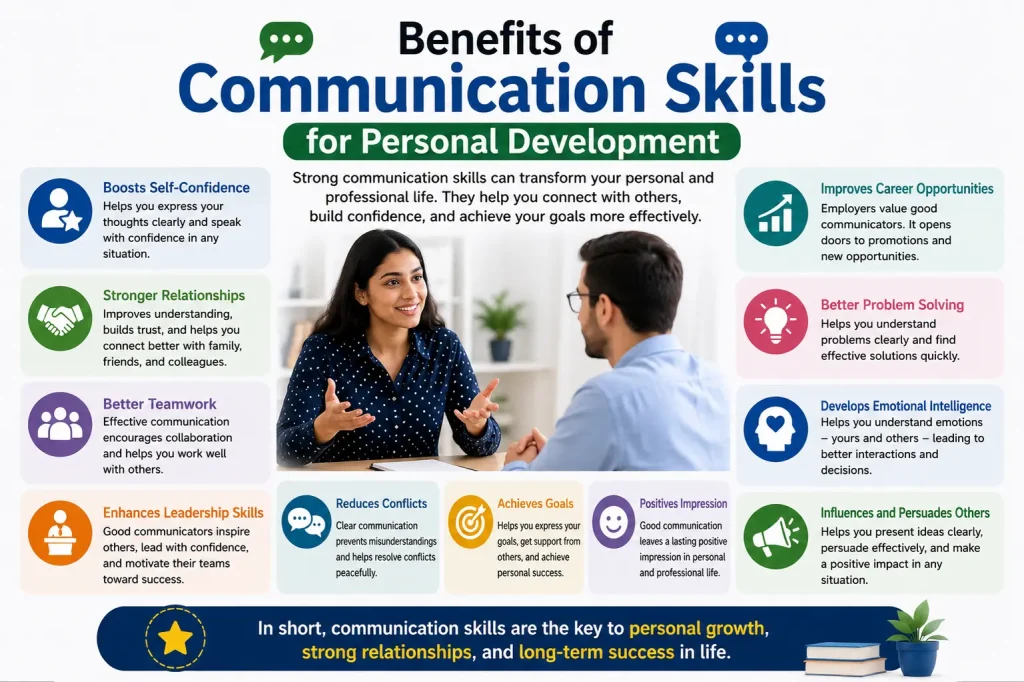
Developing effective communication skills offers numerous long-term advantages, including:
- Increased self-confidence in personal and professional situations.
- Stronger relationships with family, friends, and colleagues.
- Better teamwork and collaboration.
- Improved leadership abilities.
- Enhanced problem-solving and decision-making skills.
- Greater emotional intelligence and empathy.
- Higher productivity at work and school.
- Better conflict resolution.
- Increased career opportunities and professional growth.
- More successful networking and relationship building.
- Improved public speaking abilities.
- Greater overall personal development and self-awareness.
Disadvantages or Risks of Poor Communication
Failing to develop communication skills can create several challenges:
- Frequent misunderstandings.
- Damaged personal relationships.
- Reduced workplace productivity.
- Lower self-confidence.
- Increased conflicts.
- Missed career opportunities.
- Difficulty expressing thoughts clearly.
- Poor teamwork and collaboration.
- Stress caused by ineffective communication.
- Negative first impressions.
Fortunately, these risks can be minimized through continuous learning and regular practice.
Common Mistakes to Avoid
Many people unknowingly develop habits that weaken their communication. Avoid these common mistakes:
- Interrupting others before they finish speaking.
- Listening only to reply instead of understanding.
- Using confusing or overly complex language.
- Ignoring body language.
- Speaking too quickly.
- Failing to maintain eye contact.
- Becoming defensive when receiving feedback.
- Making assumptions without asking questions.
- Using negative or disrespectful language.
- Neglecting regular practice.
Recognizing these mistakes is the first step toward becoming a more confident and effective communicator.
What are communication skills?
Communication skills are the abilities that help people express ideas, share information, understand others, and build meaningful relationships. They include speaking, listening, writing, reading, and non-verbal communication such as body language and facial expressions.
Why are communication skills important for personal development?
Communication skills improve self-confidence, strengthen relationships, enhance leadership abilities, and increase career opportunities. They also help individuals resolve conflicts effectively and collaborate better with others.
What is active listening?
Active listening means giving your full attention to the speaker, understanding their message, asking relevant questions, and responding thoughtfully instead of interrupting. It is one of the most valuable communication skills.
How can I improve my confidence while speaking?
Practice regularly, prepare before conversations or presentations, maintain good posture, speak clearly, and focus on delivering your message rather than worrying about making mistakes. Confidence develops through consistent experience.
How long does it take to improve communication skills?
The timeline varies from person to person. With daily practice and a willingness to learn, noticeable improvement can often be seen within a few weeks, while mastering communication is a lifelong journey.
Expert Tips & Bonus Points
Developing excellent communication skills requires patience and consistency. The following expert tips can help accelerate your progress:
- Read books regularly to expand your vocabulary and improve sentence structure.
- Observe skilled speakers and notice how they use tone, pauses, and body language.
- Practice speaking in front of a mirror to improve confidence.
- Record your presentations and identify areas for improvement.
- Ask trusted friends, teachers, or colleagues for honest feedback.
- Focus on understanding before trying to be understood.
- Adapt your communication style to suit different audiences.
- Stay calm during disagreements and respond respectfully.
- Continue learning through workshops, courses, podcasts, and presentations.
- Practice every day, because small improvements lead to significant long-term results.
Bonus Points
Remember that effective communication is not about speaking the most. It is about creating understanding. People remember communicators who listen carefully, show empathy, and speak with clarity and confidence. Developing these habits consistently will make communication one of your greatest personal and professional strengths.
Conclusion
Communication skills for personal development are essential for building confidence, improving relationships, and achieving long-term success. Every conversation provides an opportunity to learn, grow, and strengthen your ability to connect with others. Whether you are speaking in public, participating in meetings, writing emails, or having casual conversations, effective communication creates positive impressions and meaningful relationships.
The good news is that communication is not a talent reserved for a select few. It is a practical skill that improves with regular practice, patience, and a willingness to learn. By becoming an active listener, speaking clearly, improving your body language, developing emotional intelligence, practicing public speaking, and accepting constructive feedback, you can transform the way you interact with people.
Personal development is a lifelong journey, and communication remains one of its strongest foundations. The more you invest in improving your communication skills, the more confident, influential, and successful you become in every area of life. Start with small daily improvements, remain consistent, and celebrate your progress. Over time, these efforts will help you build stronger relationships, unlock new opportunities, and become the best version of yourself.