
Introduction
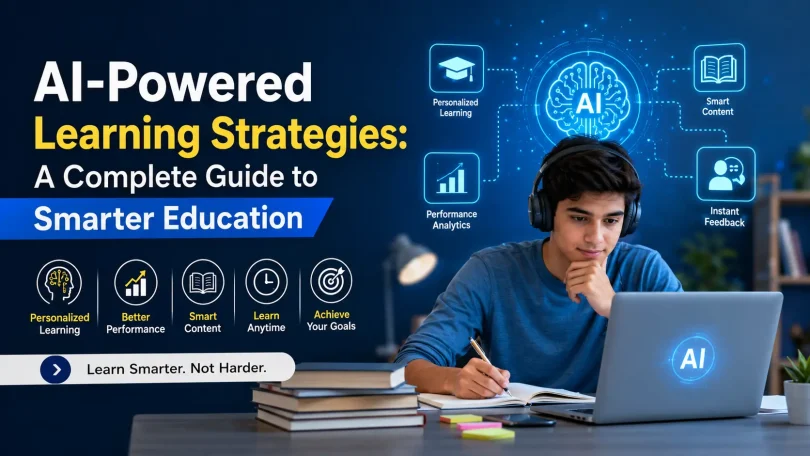
AI-Powered Learning Strategies are rapidly changing the global education landscape by introducing smarter, faster, and more personalized ways of learning. In the past, students depended heavily on textbooks, classroom lectures, and fixed syllabi. However, modern learners now have access to intelligent systems that adapt to their needs in real time.
These AI-Powered Learning Strategies use advanced algorithms to understand how each learner studies, where they struggle, and what methods help them improve. Instead of a one-size-fits-all system, learners now receive customized content designed specifically for their pace and understanding level.
Moreover, these strategies are not limited to academic education only. They are widely used in professional training, skill development courses, and even corporate learning environments. As technology continues to evolve, AI is becoming an essential companion in the learning journey.
In today’s digital-first environment, AI-Powered Learning Strategies are not just optional tools but essential components of modern education systems. Many experts believe that within the next decade, AI will become fully integrated into all levels of learning, from primary education to advanced professional training.
In this article, we will explore AI-Powered Learning Strategies in depth, covering their meaning, importance, step-by-step usage, benefits, risks, and expert recommendations. Whether you are a student, teacher, or self-learner, this guide will help you understand how to use AI effectively for better learning outcomes.
Ultimately, AI-Powered Learning Strategies are becoming a cornerstone of lifelong learning. They empower individuals to continuously upgrade their skills in an ever-changing world where knowledge quickly becomes outdated.
What is AI-Powered Learning Strategies?
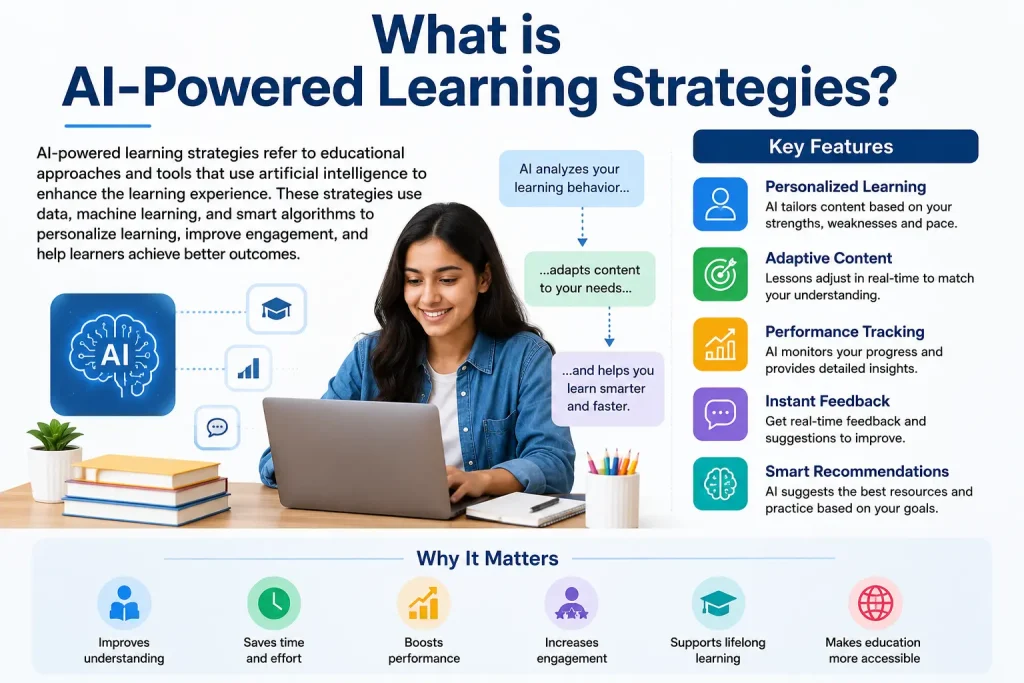
AI-Powered Learning Strategies refer to modern educational approaches that use artificial intelligence to enhance the learning experience. These strategies combine data science, machine learning, and automation to create adaptive learning environments.
The core idea is simple: every learner is different. Some learn quickly through visuals, while others prefer reading or practice-based learning. AI systems analyze these preferences and adjust content delivery accordingly.
For example, if a student is learning English grammar and repeatedly makes mistakes in tenses, the system automatically generates additional exercises focused on that topic. Similarly, if a learner excels in a subject, the system increases difficulty to maintain challenge and engagement.
At a deeper level, these systems rely on continuous feedback loops. They constantly collect data from user interactions such as quiz results, time spent on tasks, and accuracy rates. Using this data, the AI refines future lessons to match the learner’s exact needs.
These strategies are commonly used in online learning platforms, educational apps, and intelligent tutoring systems. They also include features like voice recognition, smart quizzes, predictive analytics, and real-time performance tracking.
These strategies also include natural language processing technologies that allow systems to understand student queries in real time. This enables conversational tutoring experiences where learners can ask questions and receive instant explanations, similar to a human teacher.
Another important aspect is predictive learning. AI can forecast learning difficulties before they occur by analyzing patterns in student behavior. This proactive approach ensures smoother learning experiences and fewer knowledge gaps.
Why is AI-Powered Learning Strategies Important?
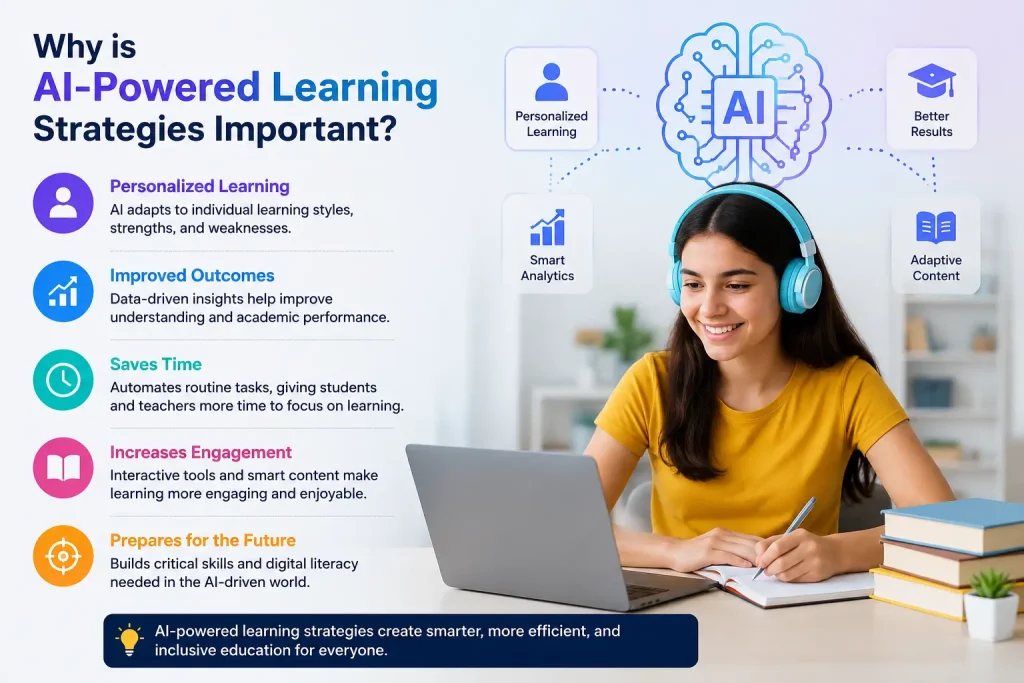
AI-Powered Learning Strategies are important because they solve many challenges found in traditional education systems. One major issue is the lack of individual attention in crowded classrooms. AI helps bridge this gap by offering personalized support to each learner.
Another important factor is learning efficiency. Traditional methods often follow a fixed pace, which may be too fast for some learners and too slow for others. AI ensures that each student learns at a comfortable and effective speed.
Additionally, AI-Powered Learning Strategies improve accessibility. Students from remote areas can access high-quality education without physical limitations. This democratization of education is one of the biggest advantages of modern learning technology.
They also support continuous improvement. Through real-time feedback, learners can instantly identify their mistakes and correct them. This reduces confusion and enhances long-term knowledge retention.
Another reason these strategies are important is their ability to reduce educational inequality. Students in underdeveloped regions can access the same quality of learning resources as those in developed areas. Additionally, AI helps teachers by automating repetitive tasks such as grading and performance analysis, allowing them to focus more on mentoring and creativity.
They are also crucial for reducing teacher workload. By automating administrative tasks, educators can dedicate more time to personalized mentoring. Moreover, AI systems help identify struggling students early, allowing timely intervention before performance declines further.
These strategies also improve global competitiveness. Students who use AI-enhanced learning systems often develop stronger analytical and problem-solving skills, preparing them better for modern job markets.
Detailed Step-by-Step Guide
Understanding Your Learning Goals
Before using any AI tools, it is important to define clear learning goals. Break them into short-term and long-term objectives. Short-term goals maintain motivation, while long-term goals provide direction.
Choosing the Right AI Tools
Select platforms that match your needs, whether academic, professional, or skill-based. Comparing features ensures better outcomes and efficiency.
Creating a Personalized Study Plan
AI tools help design structured schedules using spaced repetition, ensuring better memory retention and balanced progress.
Using Adaptive Learning Systems
Adaptive systems adjust difficulty based on performance, increasing challenge when you succeed and simplifying when needed.
Tracking Progress Regularly
AI dashboards show accuracy, speed, and improvement trends, helping learners stay motivated and focused.
Practicing Consistently
Consistency is essential. Regular practice ensures strong understanding and long-term retention.
Advanced personalization allows learners to fine-tune visual, audio, or hands-on learning preferences. Error analysis tools explain mistakes in detail, improving correction accuracy. Long-term strategies ensure steady progress instead of rushed learning.
Benefits of AI-Powered Learning Strategies
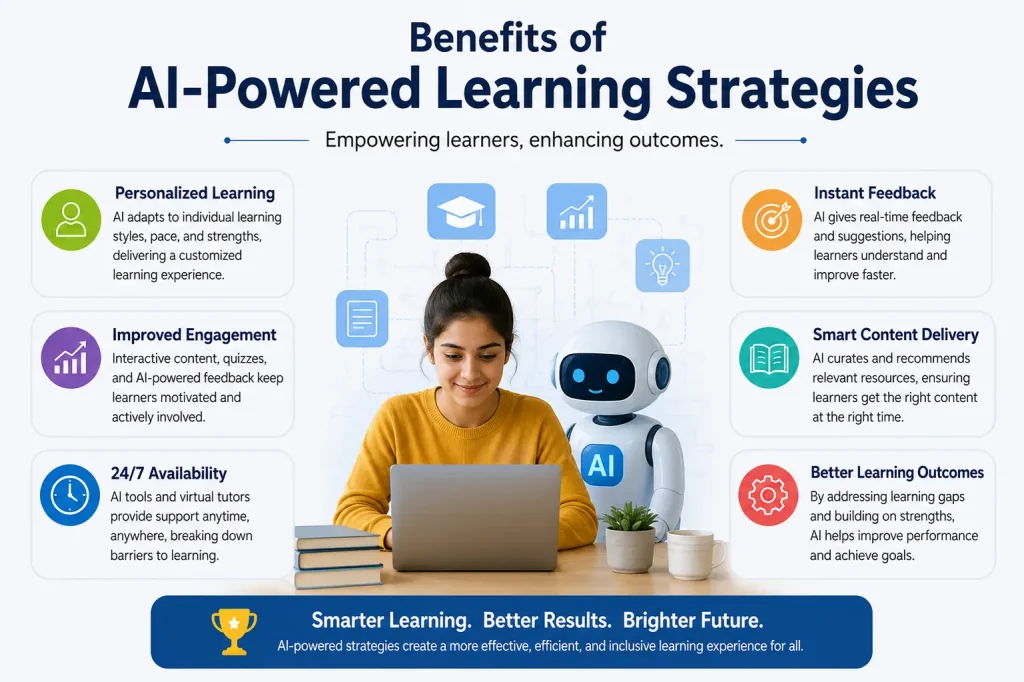
- Highly personalized learning experience
- Faster understanding of complex topics
- Improved memory retention through repetition
- Instant feedback and correction
- Increased engagement and motivation
- Flexible learning schedules
- Reduced stress through self-paced learning
- Stronger analytical thinking skills
- Better productivity and time management
- Improved digital literacy
Disadvantages / Risks
- Over-dependence on technology
- Reduced human interaction
- Privacy and data concerns
- Subscription costs for premium tools
- Technical issues or internet dependency
- Risk of reduced critical thinking skills
Common Mistakes to Avoid
Many learners rely too heavily on AI without independent practice, weakening problem-solving abilities. Others ignore traditional learning methods entirely, which reduces balance.
Some also fail to set clear goals, leading to inconsistent progress. Ignoring feedback or frequently switching platforms also slows improvement.
What are AI-Powered Learning Strategies?
They are methods that use artificial intelligence to personalize and improve learning outcomes.
How do they work?
They analyze learner behavior and adjust content based on strengths and weaknesses.
Are they suitable for beginners?
Yes, many platforms are designed specifically for beginners.
Can AI replace teachers?
No, AI supports teachers but does not replace human guidance.
Are they expensive?
Some tools are free, while advanced features may require payment.
Which subjects benefit most?
Math, science, coding, and languages benefit significantly.
Can AI help with exams?
Yes, through mock tests and revision plans.
Do they require internet?
Most advanced systems require internet access.
Are they safe?
Yes, when using trusted platforms with strong privacy policies.
Expert Tips & Bonus Points
Combine AI tools with self-study for best results. Use visual, audio, and practical learning methods together. Avoid multitasking while studying.
Set realistic goals and follow structured schedules. Take regular breaks to avoid fatigue and review progress weekly for improvement.
Stay consistent and avoid over-reliance on automation.
Conclusion
AI-Powered Learning Strategies are revolutionizing modern education by making learning more personalized, flexible, and efficient. They allow students to study at their own pace while receiving real-time feedback and adaptive support.
These strategies are especially useful for beginners and intermediate learners who need structured guidance. However, success depends on balanced usage. Over-reliance can reduce creativity and independent thinking, so a combination of AI tools and traditional methods is essential.
As education continues to evolve, AI-Powered Learning Strategies will play an even more important role in shaping the future of learning. By adopting these strategies wisely, learners can achieve better results, save time, and build stronger long-term skills.
Extended Advanced Strategies and Impact
AI learning ecosystems integrate multiple platforms for seamless education. Motivation tools like gamification improve engagement, while collaborative systems enhance teamwork and communication skills.
Educators benefit from AI insights that predict student performance and enable timely interventions. However, strong data protection and ethical standards are essential for trust and safety.
Future systems will include emotion recognition, career guidance, and immersive technologies like VR and AR. These innovations will make learning more interactive and accessible globally.
Final Supplement: Learning Optimization
Active recall and spaced repetition significantly improve retention. Time management and structured schedules enhance productivity. Combining visual, audio, and practical learning methods ensures deeper understanding.
These techniques build discipline and self-regulation skills, consistently