
Intorduce
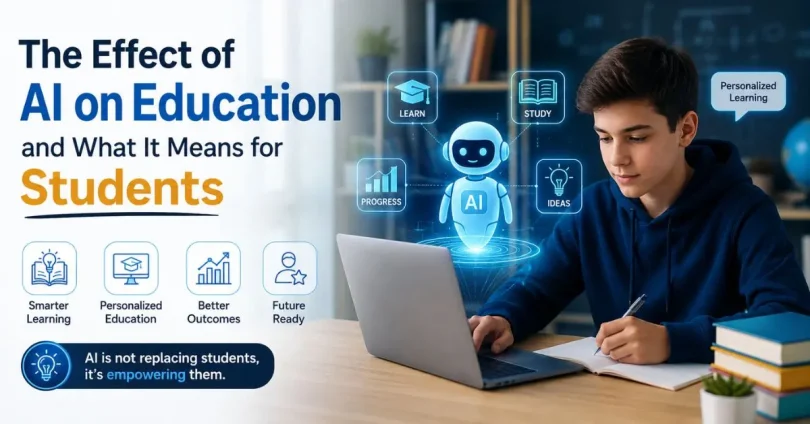
AI is changing education faster than many schools and universities expected. Students can now use AI tools to explain difficult concepts, generate practice questions, translate material, brainstorm ideas, and receive immediate feedback. Teachers can use AI to prepare lessons, create learning materials, and reduce some routine work.
But the effect of AI on education is not automatically positive or negative. It depends on how the technology is used.
Research published in 2025 found generally positive effects of generative AI on learning outcomes, although the results varied considerably depending on the educational setting, teaching method, and type of AI use. UNESCO likewise emphasizes that AI can expand learning opportunities while creating serious concerns around privacy, equity, safety, and human agency.
The real question, therefore, is not whether AI belongs in education. It is how students, teachers, and institutions can use it without allowing the technology to replace genuine learning.
What Is the Effect of AI on Education?
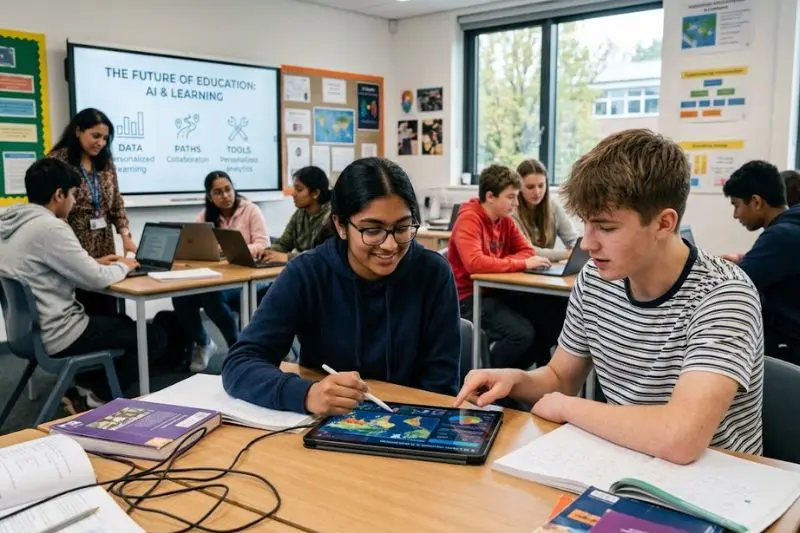
The effect of AI on education can be seen in several major areas:
- Personalized learning based on individual student needs
- Faster feedback on questions and learning activities
- Teacher assistance with lesson planning and educational materials
- Greater accessibility through translation and other support tools
- New learning methods using AI-based tutoring and practice
- Risks to critical thinking when students depend on AI for answers
- Academic integrity concerns when AI produces work submitted as the student’s own
- Privacy and equity concerns when AI systems collect data or access is unequal
This makes AI a powerful educational tool, but not a replacement for teachers or independent thinking.
How AI Is Changing the Student Learning Experience
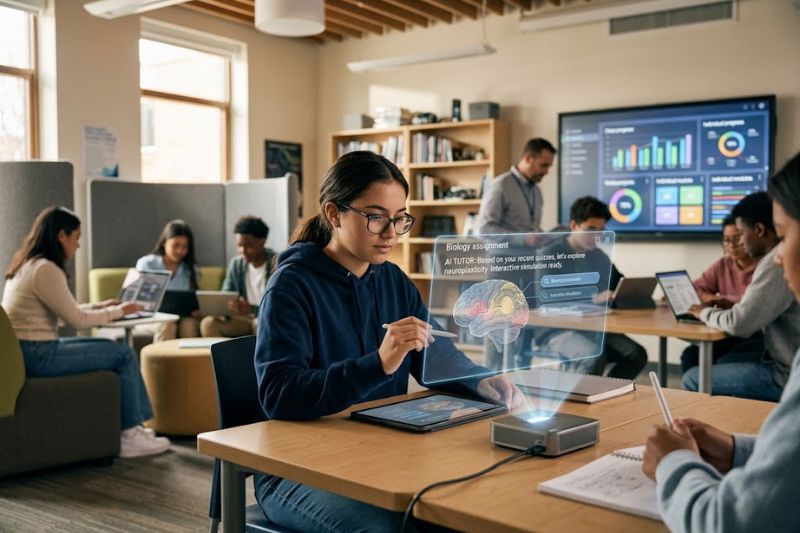
One of the biggest changes is the move from a single learning path toward more individualized support.
A traditional classroom may require one teacher to explain the same concept to many students at the same time. AI tools can provide additional explanations, examples, questions, or practice based on what a student is struggling with.
For example, a student who does not understand a mathematics concept can ask an AI system to explain it using a simpler example. The student can then ask another question immediately instead of waiting for the next class.
Recent systematic reviews have found that students are using generative AI for a range of learning tasks, with research generally showing successful actual learning outcomes but more mixed perceptions among students.
However, there is an important distinction:
Using AI to understand an answer is different from using AI to avoid learning the answer.
If a student asks AI to explain a difficult concept and then solves similar problems independently, AI can support learning. If the student simply copies an AI-generated answer, the immediate task may be completed while the underlying skill remains undeveloped.
That distinction will become increasingly important as schools and universities adapt their teaching methods.
AI Can Support Teachers Instead of Replacing Them
AI is also changing the teacher’s role.
Teachers can use AI-assisted tools for tasks such as:
- Creating lesson ideas
- Developing practice questions
- Preparing different explanations of a topic
- Adapting material for different ability levels
- Generating brainstorming ideas
- Organizing educational content
- Providing additional learning activities
UNESCO stresses that teachers remain fundamental because AI cannot reproduce the human understanding of students’ emotions, social development, and classroom relationships.
This means the strongest model is not AI versus teachers.
It is AI supporting teachers while teachers remain responsible for educational judgment.
A teacher can decide whether an AI-generated explanation is accurate, whether an activity is suitable for a particular class, and when a student needs human support rather than another automated response.
AI and Personalized Education
Personalization is one of the strongest potential benefits of AI in education.
Students do not all learn at the same speed. Some need more examples. Others need advanced material. Some understand a concept visually, while others benefit from practical explanations.
AI can help create different learning experiences around the same subject.
For instance, a teacher could use AI to develop:
- A simple explanation for students who are struggling.
- Additional practice for students who need repetition.
- More challenging problems for advanced students.
- Alternative examples for students who learn better through real-world situations.
This does not mean AI knows exactly what every student needs. Human teachers still need to evaluate the material and understand the learner.
UNESCO’s current position emphasizes using AI in ways that support inclusion and equity rather than allowing technological differences to widen existing educational inequalities.
Why the Effect of AI on Education Is Not Always Positive
The biggest mistake is to assume that easier access to answers automatically creates better learning.
It does not.
Students develop important abilities by struggling with problems, testing ideas, making mistakes, explaining concepts, and eventually reaching solutions themselves. Excessive dependence on AI can interfere with that process.
A 2025 systematic review specifically found that generative AI improved several learning outcomes but did not show a significant effect on metacognition—the ability to understand and regulate one’s own thinking.
That finding matters because education is not only about getting correct answers.
It is also about learning how to think.
Students therefore need guidance on when AI should assist their thinking and when they should work independently.
The Role of AI in Education Beyond the Classroom
The effect of AI on education extends beyond homework and classroom lessons. It is also changing how schools assess students, how teachers design learning experiences, and which skills students need to develop.
UNESCO’s recent work emphasizes that AI should enhance learning rather than replace human judgment, teachers, or learners.
AI Can Make Learning More Accessible
AI has the potential to make educational support available to students who may not have access to traditional tutoring.
A learner can use AI-based tools to:
- Ask questions outside normal classroom hours
- Request simpler explanations
- Practice a language
- Translate learning material
- Generate additional exercises
- Explore unfamiliar subjects
- Receive immediate feedback
This can be particularly useful for students who need extra practice but may not have access to private tutoring.
AI can also support multilingual and inclusive learning. UNESCO notes that AI can improve access and personalization, but warns that unequal access could create an AI divide between students who can benefit from advanced tools and those who cannot.
The Problem of Over-Reliance on AI
Convenience becomes a problem when students stop doing the thinking themselves.
Imagine a student receives an essay assignment. Instead of researching the subject, developing an argument, writing a draft, and editing it, the student asks AI to complete everything.
The final essay may look impressive. But the student may have learned very little.
This is why educators are increasingly concerned about AI becoming a substitute for learning rather than a support for learning. UNESCO discussions have specifically highlighted the risk of students becoming less skilled when AI removes productive struggle and meaningful problem-solving from the learning process.
A better approach is to use AI during the learning process.
For example:
Weak use:
“Write my assignment for me.”
Better use:
“Explain this topic, give me three questions to think about, and help me identify weaknesses in my own argument.”
The second approach keeps the student involved.
AI Is Changing Academic Assessment
One of the biggest challenges created by generative AI is assessment.
Traditional assignments often ask students to produce essays, reports, or answers outside the classroom. Generative AI can produce much of this material quickly, making it harder for educators to determine whether the submitted work represents the student’s own knowledge and skills.
UNESCO has therefore highlighted the need to rethink assessment and place greater emphasis on authentic, process-oriented demonstrations of learning.
Schools and universities may increasingly use approaches such as:
- Oral presentations
- Classroom discussions
- Project-based assignments
- Practical demonstrations
- Draft-and-revision processes
- Personalized questions
- In-class writing
- Student explanations of their reasoning
The goal is not simply to catch students using AI.
The bigger goal is to design assessments where genuine understanding matters more than producing a polished final answer.
Students Need New Skills in the AI Era
The effect of AI on education also changes what students need to learn.
Memorizing information will still have value, but students increasingly need skills that help them work intelligently with AI.
Important skills include:
Critical Thinking
Students need to question AI-generated information rather than automatically accepting it.
AI can produce confident answers that contain errors, missing context, or biased assumptions. Critical thinking helps students evaluate whether an answer is actually reliable.
AI Literacy
Students should understand what AI can and cannot do.
They should know how to:
- Write useful prompts
- Check AI-generated information
- Recognize limitations
- Protect personal information
- Use AI ethically
- Understand when human expertise is necessary
UNESCO has developed AI competency frameworks for both students and teachers to support these capabilities.
Problem-Solving
Students should still be able to approach a problem independently.
AI can suggest solutions, but students need enough subject knowledge to determine whether those solutions make sense.
Communication
AI can generate text, but students still need to communicate ideas clearly themselves.
Writing, speaking, explaining, listening, and collaborating remain important because education is not only about producing text.
How Teachers Can Use AI Responsibly
Teachers do not need to reject AI completely. Instead, they can establish clear rules around its use.
A practical classroom approach could divide AI use into three categories:
| AI Use | Example | Appropriate Approach |
|---|---|---|
| Learning support | Asking for an explanation | Generally useful |
| Learning assistance | Brainstorming ideas | Useful with review |
| Replacing student work | Submitting AI-generated assignments | Problematic |
The exact rules will differ between schools and universities, but students should know when AI is allowed, how it may be used, and when its use must be disclosed.
Teachers also need training. UNESCO’s work on higher education identifies teacher capacity, AI literacy, governance, and ethical use as important parts of successful AI integration.
Privacy and Data Are Major Concerns
Another important effect of AI on education involves student data.
AI-powered educational systems may process information about students’ activities, performance, preferences, or learning behavior. That can create useful insights, but it also raises questions about who controls the data and how it is protected.
UNESCO has warned about privacy, safety, ethical governance, and accountability when AI is used in education.
Schools should therefore consider:
- What student data is collected?
- Why is it collected?
- Who can access it?
- How long is it stored?
- Is the information shared with third parties?
- Can students or parents understand how the system uses their data?
AI adoption without proper safeguards can create problems that extend well beyond the classroom.
The Future of AI in Education
AI is unlikely to disappear from education. The more realistic question is how educational institutions will adapt to it.
The strongest future model is likely to combine AI efficiency with human judgment.
AI can handle certain repetitive tasks, provide additional explanations, support personalization, and help teachers develop learning materials. Teachers, meanwhile, remain essential for mentorship, motivation, social development, judgment, classroom relationships, and deeper learning.
UNESCO’s current approach is explicitly human-centred, emphasizing inclusion, equity, learner agency, and safeguards as AI becomes more integrated into education.
That balance will determine whether AI becomes a tool that strengthens education or a shortcut that weakens it.
How Schools and Students Can Use AI Effectively
The effect of AI on education will depend heavily on the rules and habits built around it. Simply giving students access to AI does not guarantee better learning. Schools need to teach students how to use AI responsibly, critically, and purposefully.
UNESCO recommends a human-centred approach in which AI supports learners and teachers while protecting human agency, privacy, inclusion, and meaningful learning.
5 Practical Ways Students Can Use AI for Learning
Students can get genuine value from AI when they remain responsible for the learning process.
1. Ask AI to explain difficult concepts
Instead of copying an answer, students can ask for a simpler explanation, an analogy, or an example.
For example:
“Explain photosynthesis as if I am 12 years old, then give me three questions to test my understanding.”
This turns AI into a learning assistant rather than an answer generator.
2. Use AI for practice
Students can ask AI to create quizzes, flashcards, practice problems, or mock questions.
The important part is to answer the questions independently first.
3. Use AI for feedback
A student can write an essay and ask AI to identify unclear arguments, grammar problems, or missing explanations.
The student should then decide which suggestions actually make sense.
4. Use AI for brainstorming
AI can help students generate possible research questions, project ideas, or different perspectives on a topic.
The student should still research, evaluate, and develop the final idea.
5. Verify important information
AI-generated information should not automatically be treated as fact.
Students should compare important claims with textbooks, academic sources, official websites, or teacher guidance.
UNESCO specifically recommends that learners develop the ability to question AI outputs and understand the methodologies, accuracy, and assumptions behind AI systems.
What Schools Should Teach About AI
AI literacy should become part of education rather than something students learn accidentally.
UNESCO’s AI competency framework for students focuses on areas including human-centred thinking, ethics, safe and responsible use, AI foundations, application skills, and AI system design. It organizes these skills across increasing levels of understanding, application, and creation.
A modern AI education program should therefore teach students:
- What AI is and how it works at a basic level
- What AI systems are good at
- Where AI systems can fail
- How to evaluate AI-generated information
- How to protect personal data
- How to use AI ethically
- How AI can contain bias
- When human judgment is necessary
- How to use AI without becoming dependent on it
This is broader than simply teaching students how to write better prompts.
AI Should Not Replace Human Interaction
Education is more than information delivery.
Students also learn through:
- Classroom discussion
- Collaboration
- Experiments
- Debate
- Social interaction
- Creative activities
- Teacher feedback
- Real-world experiences
UNESCO’s guidance specifically warns against using GenAI in ways that remove opportunities for students to develop cognitive abilities and social skills through independent reasoning, experimentation, and interaction with other people.
That is why an AI-powered education system should not become a classroom where students spend all day talking to machines.
AI should create more opportunities for meaningful learning, not fewer.
The Digital Divide Could Become an AI Divide
Another major issue is unequal access.
Some students may have fast internet, powerful devices, paid AI tools, and knowledgeable teachers. Others may have limited connectivity or no access to advanced AI systems.
If schools assume that every learner has equal access, existing educational inequalities could become worse.
UNESCO identifies inclusion and equity as central considerations in responsible AI adoption and warns that AI development can contribute to widening digital inequalities if access is not addressed.
Schools should therefore consider access to:
- Reliable internet
- Suitable devices
- Accessible AI tools
- Teacher training
- Digital literacy
- Technical support
The goal should be to make AI a tool for expanding educational opportunity, not another advantage available mainly to students who already have more resources.
A Better Model for AI-Assisted Education
The most useful way to think about AI in education is not teacher + AI versus teacher.
It is:
Student + Teacher + AI
Each has a different role.
| Role | Main Strength |
|---|---|
| Student | Thinking, practicing, creating, questioning |
| Teacher | Judgment, mentorship, context, motivation |
| AI | Assistance, explanations, practice, idea generation |
AI can provide speed and scale, but teachers provide human judgment and students provide the actual learning effort.
This division of responsibility is important because AI systems can generate convincing but incorrect information. Students therefore need enough knowledge to question what AI produces rather than simply accepting it.
What the Future of Education May Look Like
AI may eventually become a normal part of educational infrastructure, much like search engines, computers, and online learning platforms.
Students may use AI tutors for additional practice. Teachers may use AI to prepare differentiated materials. Schools may use AI-assisted systems to identify areas where students need additional support.
At the same time, assessment may become more focused on what students can explain, demonstrate, create, and defend themselves rather than simply what they can submit.
UNESCO’s guidance argues that generative AI is already pushing education systems to reconsider what students should learn, how they should learn it, and how learning should be assessed.
That could ultimately be one of AI’s most important effects on education.
It may force education systems to place greater value on reasoning, creativity, communication, practical skills, and genuine understanding.
The Key Principle
The goal should not be to keep students away from AI.
The goal should be to make students capable of using AI without losing the ability to think independently.
That distinction will shape whether AI becomes a powerful educational partner or an easy shortcut that weakens learning.
Common Mistakes When Using AI in Education
AI can be useful in education, but several mistakes can reduce its value or create new problems.
1. Using AI Instead of Learning
The biggest mistake is asking AI to complete every difficult task.
If students always rely on AI for essays, calculations, research, or problem-solving, they may finish assignments without developing the underlying skills.
Better approach: Use AI to explain, practice, question, and review—but do the important thinking yourself.
2. Trusting Every AI Answer
AI can produce information that sounds correct but is inaccurate or incomplete.
Students should verify important information before using it in assignments or making decisions.
Better approach: Compare important claims with textbooks, academic sources, official resources, and teacher guidance.
3. Ignoring Academic Integrity
Submitting AI-generated work as entirely your own can violate an institution’s academic policies.
Rules differ between schools and universities, so students should understand the specific requirements that apply to their assignments.
Better approach: Follow the teacher’s instructions and disclose AI assistance when required.
4. Sharing Private Information
Students should avoid entering sensitive personal information into AI systems without understanding how that information may be handled.
Better approach: Use caution with names, addresses, passwords, private documents, personal records, and other sensitive information.
5. Assuming AI Can Replace Teachers
AI can explain information, but education involves much more than information.
Teachers understand classroom dynamics, student development, motivation, social interaction, and individual circumstances in ways an AI system cannot fully reproduce.
Better approach: Treat AI as an additional educational tool, not a replacement for qualified teachers.
Is AI good or bad for education?
AI can be both beneficial and harmful. It can provide personalized support, faster feedback, accessibility, and learning assistance. At the same time, excessive dependence can create problems involving critical thinking, academic integrity, privacy, and unequal access.
The outcome depends largely on how AI is used and how well its use is guided.
How does AI affect students?
AI can help students understand difficult topics, practice skills, brainstorm ideas, receive feedback, and access learning support. However, students who depend on AI too heavily may reduce their own problem-solving and independent-thinking practice.
Will AI replace teachers?
AI is unlikely to replace the full role of teachers because teaching involves human judgment, mentorship, communication, motivation, classroom relationships, and social development. AI is more useful as a tool that can support teachers with certain tasks.
Can AI improve personalized learning?
Yes. AI can provide different explanations, exercises, examples, and feedback based on a learner’s needs. However, personalization works best when teachers remain involved in deciding what students actually need.
Is AI-generated content reliable for schoolwork?
Not automatically. AI-generated content should be checked for accuracy, especially when it contains facts, statistics, references, historical information, scientific claims, or other information that needs verification.
How should students use AI responsibly?
Students should use AI to support learning rather than avoid learning. Good uses include asking for explanations, creating practice questions, brainstorming, receiving feedback, and exploring different perspectives. Students should follow their institution’s academic-integrity rules and verify important information.
What skills will students need in an AI-powered education system?
Students will increasingly benefit from critical thinking, AI literacy, communication, creativity, problem-solving, research skills, and the ability to evaluate information. Knowing how to use AI is useful, but knowing when not to trust or depend on AI is equally important.
The Future of AI and Education
The effect of AI on education will not be determined by technology alone. It will depend on the decisions made by students, teachers, parents, schools, universities, and policymakers.
Used carefully, AI can make learning more personalized, accessible, interactive, and efficient. It can give students additional support and help teachers spend less time on certain routine tasks.
Used carelessly, the same technology can encourage dependency, weaken independent thinking, create academic-integrity problems, expose personal data, and increase educational inequality.
The best approach is therefore neither to accept AI without limits nor to reject it completely.
Students should learn with AI without allowing AI to do all of their learning for them. Teachers should use AI to strengthen teaching rather than replace human interaction. Educational institutions should create clear rules that protect learning, privacy, fairness, and academic integrity.
AI is changing what education can look like. The real opportunity is to use that change to create better learning—not simply faster answers.